MAKING LIGHT WORK: The Science of Optics - 1. Light Rays and Shadow Plays

Figure 1. The Sun is the biggest and brightest source of light on Earth.
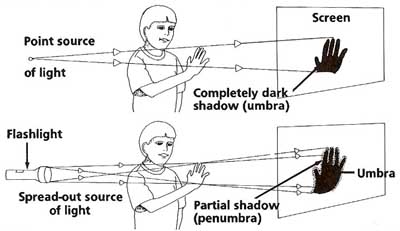
Figure 2. Molecules in a solid, a liquid, and a gas.
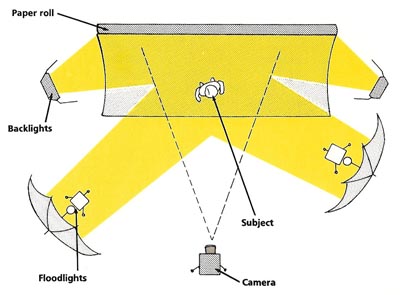
Figure 3. Lights in a studio are directed at different angles to remove shadows.
What do rainbows, glow worms, candles, telescopes, and compact disk players have in common? The answer is that they all depend in some way upon light.
Light is not a form of matter – a solid, liquid, or gas. It cannot be held or stored. Yet it can cause change. It can affect the chemicals in a photographic film so that a picture appears on the film. It can also cause changes in the sensitive layer at the back of our eyes, enabling us to see. When any change takes place, energy is involved. So, light is a form of ENERGY.
The biggest, brightest source of everyday light is the sun (see Figure 1). Traveling at 186,282 miles per second – the highest speed in the universe – light takes 8 1/3 minutes to cross the 93-million-mile gap between the sun and Earth.
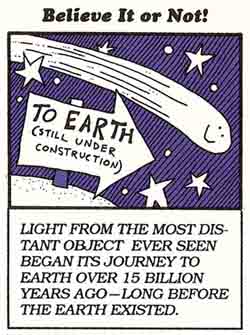
Light from more distant objects takes longer to reach us. For example, if you look at the brightest star in the night sky, Sirius, you see it as it was 8 years ago. Because it takes light time to reach us, the farther we look back in time.
Light and Matter
Light can travel through empty space, and it can also travel through certain kinds of matter. Substances such as glass, water, and air, which let light pass right through them, are called TRANSPARENT.
Other materials, including frosted glass, tracing paper, and uncut diamonds, allow only some light to pass through. They are said to TRANSLUCENT. Still other substances block out all the light that falls on them and called OPAQUE.
Most objects do not give off any light of their own. We can see them only by the light they reflect from the sun or from artificial sources such as electric lights and candle flames.

Making ShadowsYou will need:
What to do:
Fix the card upright against a wall. With the room darkened, shine the light at the card. Hold a solid object, such as your hand or a book, in front of the card. Look at the shadow that is cast. What happens to the size of the shadow as you move the object, first nearer and then farther away from the light?
Mark two marks on the card two feet apart. Start with the 12" ruler against the card and move it toward the source of light until the shadow of the ruler just stretches between the two marks. Measure the distance from the ruler to the light and the distance from the card to the light. Divide the first measurement by the second. To double the size of the shadow, what do you have to do to the ruler's distance from the light source? What would you have to do to make the shadow four times bigger?
Take one of the regular-shaped solids and cast its shadow. Turn the object slowly around. What happens to the shadow. Remember, the shape of the shadow is the same as the outline of the object as seen from the direction of the light. Try the other regular-shaped solids and see how many different regular-shaped shadows you can create from them. For example, from a cone you should be able to make a circle and a triangle. Record your findings in a table.
Taking it further:
Start with an object almost touching the screen. Look closely at the edge of the shadow. Now gradually move the object toward the light (see Figure 2). What happens to the edge of the shadow? Invent a hypothesis to explain your observation.
The shadows thrown by an ordinary source of light, such as a lamp or candle, are never completely sharp. What is more, the blurring of the shadow becomes greater as the object is moved nearer to the light. Why should this be?
If a light source were just a point, without any size, then it would give perfectly sharp-edged shadows. This situation is shown in the first of the two diagrams here. But ordinary light sources are not just points. They have a definite size. As a result, the shadows they produce consist of two regions. The completely dark central part, where no light from anywhere on the source can get past the object, is called the UMBRA. Around this is a region of partial shade – the PENUMBRA – into which light from some but not all parts of the source manages to fall. The second of the diagrams shows how this happens.
To test these ideas, make a small hole in the middle of a thick piece of card. Then tape the card over your light source so that the hole is exactly over the center of the beam. Observe what effect this has on the shadows that are cast. |
Light and Shadows
The next time you go to the movies and the action begins on the screen, turn your back on it for a moment. Look in the direction of the projector. Particles of dust in the air scatter some of the light from the projector so that you can see the beam. Notice that the beam is straight. Light always travels along the most direct path that it can.
An opaque object blocks the light that falls on it. Everywhere else, the light continues in a straight path until it bounces off the ground or wall behind. The result is a dark patch, or shadow, with the same outline as the object, surrounded by light.
A Photographer's Studio
If you have your picture taken in a studio, you will notice that the photographer uses a variety of different lights (see Figure 3). Two or more floodlights are set up to light you equally from both sides, so that no shadows fall on your face. These floodlights shine backward into an umbrella reflector that produces a broad, even beam.
In addition, two or more "backlights" are placed on each side of you. These shine directly onto the screen behind you to remove shadows the floodlights cast. A similar though more complicated arrangement of lights is used when photographing fashion models indoors or shooting movies on a studio set.
Eclipses
The moon and the sun seem to be almost exactly the same size as seen from Earth. This is because although the sun is about 400 times bigger than the moon, it is also about 400 times father away.
 |
| An eclipse of the sun
|
As a result, when the moon passes directly between the sun and Earth, it just covers the sun's bright face. From certain places on Earth, the sun is blocked out and the sky grows dark. This is called a total solar ECLIPSE. For a few minutes, someone standing in the shadow cast by the moon can glimpse the faint outer atmosphere of the sun. Then the moon's shadow races on, making a track across the Earth only a few hundred miles wide.
 |