SOUNDS INTERESTING: The Science of Acoustics - 1. Good Vibrations
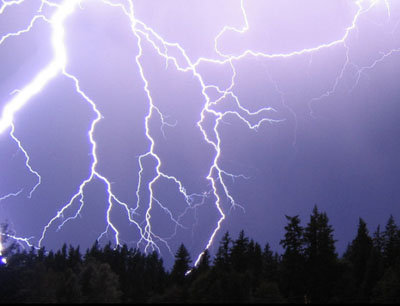
Figure 1. The sounds produced during a thunderstorm are among the loudest in nature.
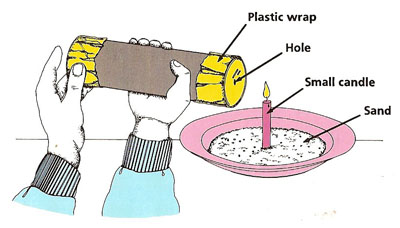
Figure 2. 'Sound gun' experiment.
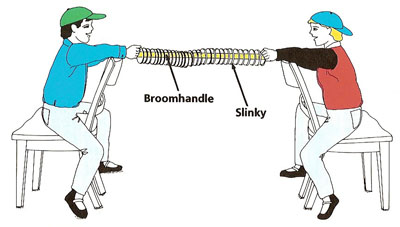
Figure 3. Slinky experiment.
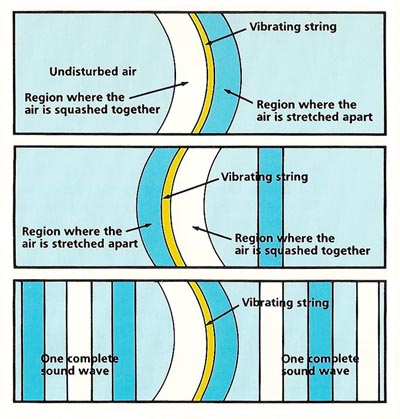
Figure 4. A vibrating string pushes and pulls on the air around it.

Figure 5. What do you hear when a friend taps a wall some distance away?

Figure 6. What do you hear through your cup and string 'telephone'?
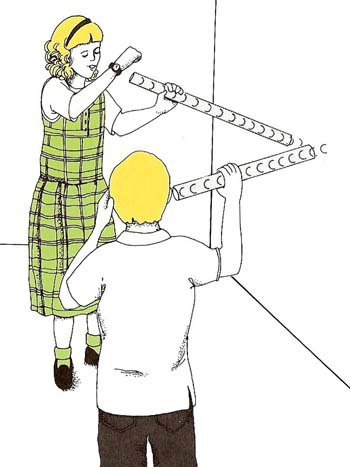
Figure 7. Experimenting with echoes
The world is full of sound – a dog's bark, the wail of a police siren, the chatter of students in a classroom. Even when everything outside is quiet, you can still hear your own breathing and the steady beating of your heart.
Sound is one of the most important ways we have of sensing our surroundings and communicating with other people. Sometimes it can be a nuisance, as when an airplane or a car roars by. Then we call it noise. On the other hand, many sounds, such as those of musical instruments, are extremely pleasant.
Sounds come in every variety imaginable. But what exactly is sound? How is it made and how does it travel?
Sound Energy
Sound is a form of energy. This fact becomes most clear when a loud sound causes something nearby to rattle or move about. For example, if a television set or a record player is turned up high, the sound from it may cause small objects in the room to shake.
Sound energy is produced by anything that moves back and forth. A mosquito's wings, for instance, beat back and forth rapidly. This causes similar back-and-forth movements, or vibrations, in the surrounding air. When the air vibrations reach our ears we hear the mosquito's familiar hum.

A "Sound Gun"You will need:
What to do:
Cover both ends of the tube with plastic wrap. Make sure that the plastic is stretched tight. Use the nail to make a small hole in the middle of the plastic at one end. Put some sand in the dish and stand the candle upright in the sand. Light the candle. Hold the "sound gun" so that the hole is about 1" from the candle flame. Tap the plastic at the other end of the tube with your finger (see Figure 2). What do you hear? What happens to the flame? Try to explain your observations.
Warning: Always be careful when using matches. If in doubt ask an adult for help. |
|
Making WavesYou will need:
What to do:
Thread the coils of the Slinky on to the broom handle. Rest the broom handle across the backs of the two chairs, as shown. Hold the Slinky by both ends and pull it apart, without stretching it too far. Jerk one end slightly. Observe how the coils of the Slinky move. Jerk one end hard, then more gently (see Figure 3). Notice what happens in each case.
Hold one end of the jump rope and ask a friend to hold the other end. Shake your end of the rope once. Shake it hard and then more gently. What do you observe?
The Slinky and the jump rope behave like a length of air. When you jerk or shake one end, you set up a vibration. The way the Slinky and jump rope move is similar to the way air moves when an object vibrates nearby. |
Pushes and Pulls in the Air
The air next to a vibrating object is alternately squeezed together and pulled apart as the object moves back and forth. This causes the air farther away to be squeezed together and pulled apart, too (see Figure 4).
You can picture how this works by thinking about a long line of people, in which each person is holding on to the shoulders of his or her neighbor in front. If the person at the very back suddenly pushes forward, a wave of pushes travels down the line. If the same person pulls back, a wave of pulls is set in motion. The bigger the starting push or pull, the bigger the wave that spreads out. In the same way, an object makes a louder sound if its vibrations are large than if they are small.
Sound and Matter
Sound waves do not only travel through air. In water, sound can be heard over great distances. Whales, for example, seem to be able to communicate with each other underwater even if they are tens of hundreds of miles apart.
Sound can only pass easily through hard materials such as metal, stone, bone, wood, and glass. Soft substances, however, including fabric and rubber, quickly absorb sound waves. They can be used to deaden the noise of a car engine or prevent echoes in a concert hall.
The one thing that no sound can travel through is empty space. So, when astronauts visited the moon they had to communicate using radios. Only by touching helmets would they have been able to talk to ne another directly. This would have allowed the vibrations of their voices to pass through the material of their helmets.
Sometimes you will see movies in which spacecraft make noises when their engines are fired or they are hit by the enemy. But, in truth, all such action would be completely silent from outside.
|
Something to Travel ThroughYou will need:
What to do: Stand with your ear next to brick wall. Ask a friend to tap on the wall some distance away (see Figure 5). Can you hear anything? Can you hear the tapping if your ear is not pressed to the wall? If so, does it sound the same?
Strike the tuning fork and hold it just in front of your chin. Listen. Strike it again and press the rounded end of the tuning fork against your chin. Listen once more. Is the sound louder, quieter, or about the same? Try to explain your results by thinking about how the vibrations of the tuning fork are carried to your ear.
The next time you are in a swimming pool or a bath, lie back so that your ears are underwater. Can you hear anything? If so, how is that possible?
Make a hole in the bottom of each plastic cup. Cut off a length of about 30 feet of fine string. Push one end of the string through the hole in one cup and the other end through the hole in the other cup. Knot the string to stop it from coming out of the holes. Stand facing a friend and pull the string tight. Hold your cup to your ear while your friend talks slowly and clearly into the other cup (see Figure 6). What do you hear? What happens if you let the string go slack?
Taking it further: Record a passage from a book on the tape recorder. Hold your cup to your ear while your friend holds the other cup to the loud speaker of a tape recorder. Again. keep the string tightly stretched. Repeat the experiment using a 30-foot length of fishing line instead of fine string. Does this affect the quality of what you hear? Can you explain your results? Repeat the experiment using coarse string. Again, describe your findings. |
Echo, Echo
 |
| Locating fish with sonar
|
When sound waves strike a hard, solid object, such as the side of a building, they bounce back. That is, they are reflected. A softer surface, however, soaks up most of the energy in the sound waves and reflects very little. This explains why sounds in a bare room appear very loud, but in a room with carpeting, curtains, and soft furnishings, sounds are more muffled.
A sound that bounces back is called an ECHO. If you stand a long distance away from a large wall or a steep mountain and shout, your calls will return to you a short time later. The farther you are from the reflecting surface, the longer is the gap between making the call and hearing the echo. Why do you think this should be?
Ships and submarines use beams of sound to measure the depth of water, to chart the seabed, and to find shoals of fish. The system is called SONAR, which stands for sound navigation and ranging. A device under the hull sends out regular pulses of sound. These bounce off the seabed or off shoals of fish and return to the ship. After the echoes have been picked up, they are turned into a picture on a screen.
|
Bouncing Sounds AroundYou will need:
What to do:
Ask a friend to hold one of the tubes at an angle to the wall with the ticking watch at the other end of the tube. Hold the other tube to your ear and aim it at the same spot on the wall as your friend's tube is pointing (see Figure 6). Can you hear anything? If not, alter the angle your tube makes with the wall (still pointing at the same spot). Is there anything special about the position at which you can hear the watch? What does this tell you about what is happening to the sound waves when they hit the wall? |