SPIDERWEBS TO SKYSCRAPERS: The Science of Structures - 6. Home Grown
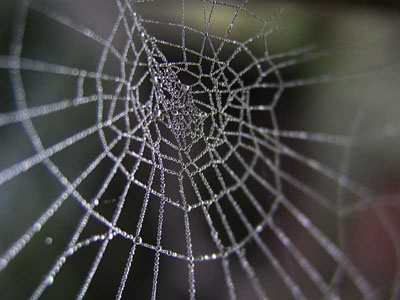
Figure 1. Spider's web.
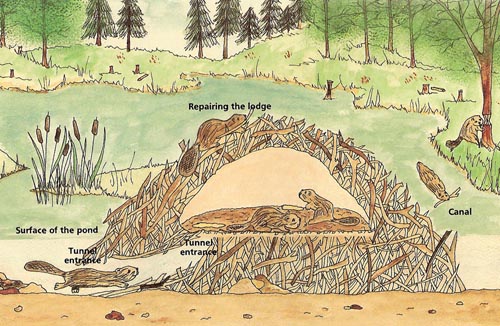
Figure 2. Activity in and around a beaver lodge.
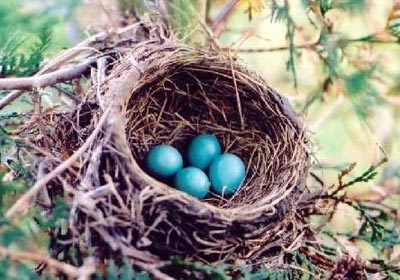
Figure 3. An American robin's nest.
Many of the world's most amazing structures are not made by human beings at all. Termites, for example, build tall towers of mud and saliva, a mixture that sets hard as concrete. Rising up to twenty feet high, these towers provide ventilation for the main nest, which is below ground level.
Spiders build webs from a silky substance than is stronger than steel if stretched out to the same thickness (see Figure 1). In fact, at an army research center near Boston, scientists are trying to develop superstrong lightweight fibers based on spiders' silk. These could be used, for example, in parachutes or bullet-proof clothing. We can learn much from the structures and building materials of animals and plants.

Webs: A Fly's-Eye ViewYou will need:
What to do:
Find a spider's web and examine it carefully with the magnifying glass. Sketch or describe any features you can see on the strands. If possible, identify the type of spider that made the web.
Place the slide behind a section of the web and lift it away so that one or two strands stick to the middle of the glass. Put the slide under the lowest power of the microscope. Make a careful sketch of what you see. Do some strands of this web appear different than others? Increase the magnification and see if this brings any more detail into view.
Repeat these observations with webs made by other kinds of spiders. |
Spider Traps
The webs of spiders work in two main ways. Some webs have "capture" threads that are covered with small sticky droplets to ensnare prey. Other webs, built by a different family of spiders, are dry. These dry webs consist of a fuzz of fine threads with loops and barbs for holding on to their victims.
The Master Builder
The largest and most spectacular animal constructions are the dams and lodges built by beavers in North America (see Figure 2). The beaver's long front teeth grow throughout its life and are kept to a manageable length by gnawing at the trunks and branches of trees. A beaver can fell a tree three feet thick. It floats the wood down the river to the site where the dam is to be built. The animal carries mud and stones in its forepaws and adds them to the branches to form the dam wall.
Some distance behind the dam, in the lake that has been formed, the beavers build a dome-shaped "lodge." This provides a warm, safe shelter for one or more family groups. The entrances are underwater so that they remain open even when the surface is frozen over in winter.
Beavers can strip the lake shore of all trees to a distance of several hundred yards. When they have done this, they simply move on to a new site. Eventually, the old site becomes clogged with mud. New vegetation then grows on the rich soil created by the beavers' building.
|
Make Like a BirdYou will need:
What to do:
Make sure that the bird's nest is no longer in use before you touch or remove it (see Figure 3). Use rubber gloves if you wish, since the nest is likely to contain various bugs. Weigh the whole nest. Observe closely how it has been made. How does it hold itself together? How have the various materials been used in its construction? Carefully pull the nest apart over a sheet of paper and sort the contents into piles – twigs on one sheet of paper, feathers on another, and so on. Weigh the various piles and work out what percentage each represents of the total weight of the nest.
Now attempt to make your own nest from scratch. Can you equal or improve on the bird's design? Remember, only use building materials that would be available to the bird, though these could include human-made articles that have been thrown out. |
 |