
cellular porous ceramic
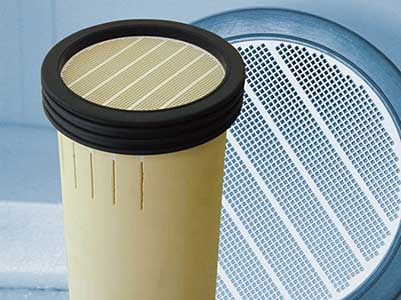
Cellular ceramic membrane filters. Photo courtesy of Corning Incorporated.
Cellular ceramics are unique in their combination of valuable properties, with a low density, low thermal conductivity, low dielectric constant, high thermal shock resistance, high specific strength, and high chemical resistance. This makes them useful for both structural and functional applications (thermal insulation, liquid metal filtration, impact absorption, catalyst supports, lightweight structures.)
The process of obtaining silicon oxycarbide (SiOC) ceramic foams is simple, economical and versatile, and consists of co-blowing a silicone resin with or without polyurethane precursors (polyols and isocyanates). The green porous bodies are converted into a SiOC ceramic foam by pyrolysis in nitrogen, and both open and closed cell macro cellular foams can be produced. This makes it possible to produce porous ceramics in any shape or design according to specification; rods, tubes, and thin plates are typically manufactured.
Porous ceramics are used in gas absorption, chromatography, vacuum holding plates and filtration for heavy metal ions in water.