
Chagas disease
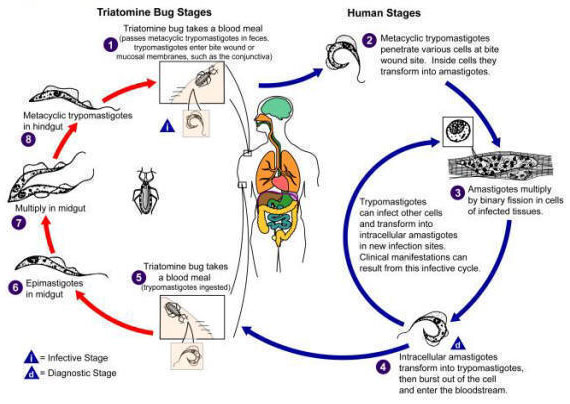
Transmission cycle of Chagas' disease (American trypanomiasis).
Chagas disease, also known as American trypanomiasis, is a parasitic disease found only on in poor rural areas of South and Central America, caused by the trypanosome Trypanosoma cruzi (a parasitic protozoan) and carried by insects. Especially prevalent in children and young adults, it is transmitted to humans when the trypanosomes, present in the feces of nocturnal reduviid bugs, come into contact with wounds and scratches on the skin or the delicate internal tissues of the nose and mouth. The presence of the parasite in the heart muscles and central nervous system results in serious inflammation and lesions, which can prove fatal. In the acute form, there is swelling around the eye, fever, malaise, enlargement of lymph nodes, liver, and spleen, and edema. Most cases, however, recover fully. Treatment is possible with nifurtimox. The disease is named after the Brazilian physician C. Chagas (1879–1934).

