
HD 187123
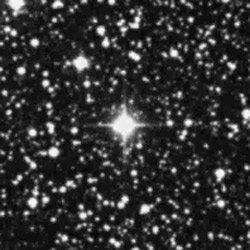
HD 187123 is a star almost identical to the Sun, in the constellation Cygnus, around which has been discovered a planet with at least half the mass of Jupiter. At one ninth the average separation distance of Mercury from the Sun, HD 187123 b orbits more closely to its host star than any other planet discovered up to that time.1 See also exoplanets.
| Host star | |
|---|---|
| distance | 156.3 light-years (47.92 pc) |
| spectral type | G5V |
| apparent magnitude | 7.89 |
| temperature | 5,560°C |
| luminosity (Sun=1) | 1.35 |
| mass (Sun=1) | 1.0 |
| position | RA 19h 46m 58.11s; Dec +34° 25' 10.29" |
| other catalog designations | BD+34°3708, HIP 97336, SAO 68845 |
| Planet | |
|---|---|
| mass (Jupiter=1) | > 0.52 |
| semi-major axis | 0.042 AU (6.3 million km, 3.9 million mi) |
| orbital period | 3.097 days |
| eccentricity | 0.03 ± 0.003 |
| discovery | 1998, Butler et al., SFSU Planet Search, Keck |
| method | radial velocity |
References
1. Butler, P., Marcy, G., Vogt, S., and Apps, K. "A Planet with a 3.1-day Period Around a Solar Twin," Publications of the Astronomical Society of the Pacific, 110, 1389 (1998).

