
humors
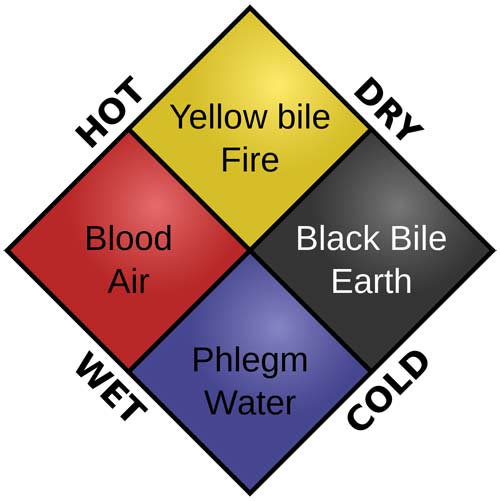
The four humors and their qualities.
In ancient and medieval science, the humors are the four bodily fluids whose balance was required for the individual's health. They correspond to the four elements in Aristotle's philosophy: blood: fire; phlegm: water; choler (or yellow bile): air; and melancholy (or black bile): earth.
Excess of blood (hot and dry), for example made one sanguine; phlegm (cold and wet), phlegmatic; etc. Cure was by enantiopathy, so that a fever would be treated with cold, and so forth.
The idea may have originated with Empedocles in the 5th century BC, and we still retain something of it in modern words such as "choleric" and "phlegmatic."

