
knee disorders
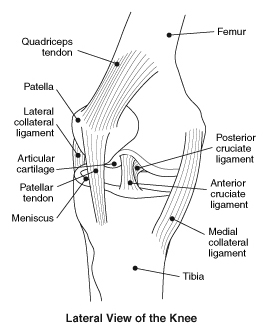
Mechanical problems with the knee can be caused by:
Inflammatory knee problems can be caused by certain rheumatic diseases, such as rheumatoid arthritis and systemic lupus erythematosus (lupus). These diseases cause swelling which can damage the knees permanently.
How are knee problems diagnosed?
Doctors diagnose knee problems by using:
Arthritis in the knees
The most common type of arthritis of the knee is osteoarthritis. In this disease, the cartilage in the knee gradually wears away. Treatments for osteoarthritis are:
Rheumatoid arthritis is another type of arthritis that affects the knee. In rheumatoid arthritis, the knee becomes inflamed and cartilage may be destroyed. Treatment includes:
Cartilage injuries and disorders
Chondromalacia occurs when the cartilage of the knee cap softens. This can be caused by injury, overuse, or muscle weakness, or if parts of the knee are out of alignment. Chondromalacia can develop if a blow to the knee cap tears off a piece of cartilage or a piece of cartilage containing a bone fragment.
The meniscus is a C-shaped piece of cartilage that acts like a pad between the femur (thigh bone) and tibia (shin bone). It is easily injured if the knee is twisted while bearing weight. A partial or total tear may occur. If the tear is tiny, the meniscus stays connected to the front and back of the knee. If the tear is large, the meniscus may be left hanging by a thread of cartilage. The seriousness of the injury depends on the location and the size of the tear.
Treatment for cartilage injuries includes:
Ligament injuries
Two commonly injured ligaments in the knee
are the anterior cruciate ligament (ACL) and the posterior cruciate ligament (PCL). An injury to these ligaments
is sometimes called a "sprain." The ACL is most often stretched or torn
(or both) by a sudden twisting motion. The PCL is usually injured by a direct
impact, such as in an automobile accident or football tackle.
The medial and lateral collateral ligaments are usually injured by a blow
to the outer side of the knee. This can stretch and tear a ligament. These
blows frequently occur in sports such as football or hockey.
Ligament injuries are treated with:
Tendon injuries and disorders
The three main types of tendon injuries and disorders are:
Tendon injuries range from tendinitis (inflammation of a tendon) to a ruptured (torn) tendon. Torn tendons most often occur from:
One type of tendinitis of the knee is called jumper's knee. In sports that require jumping, such as basketball, the tendon can become inflamed or can tear.
Osgood-Schlatter disease is caused by stress or tension on part of the growth area of the upper shin bone. It causes swelling in the knee and upper part of the shin bone. It can happen if a person's tendon tears away from the bone, taking a piece of bone with it. Young people who run and jump while playing sports can have this type of injury.
Iliotibial band syndrome occurs when a tendon rubs over the outer bone of the knee causing swelling. It happens if the knee is overused for a long time. This sometimes occurs in sports training.
Treatment for tendon injuries and disorders includes:
Other knee injuries
Osteochondritis dissecans occurs when not enough blood goes to part of the bone under a joint surface. The bone and cartilage gradually loosen and cause pain. Some cartilage may break off and cause sharp pain, weakness, and locking of the joint. A person with this condition may develop osteoarthritis. Surgery is the main treatment.
If cartilage fragments have not broken loose, a surgeon may pin or screw them in place. This can stimulate new blood flow to the cartilage. If fragments are loose, the surgeon may scrape the cavity to reach fresh bone and add a bone graft to fix the fragments in position. Research is being done to investigate cartilage and tissue transplants.
Plica syndrome occurs when bands of tissue in the knee called plicae swell from overuse or injury. Treatments for this syndrome are:
What kinds of doctors treat knee problems?
Injuries and diseases of the knees are usually treated by an orthopaedist (a doctor who treats problems with bones, joints, ligaments, tendons, and muscles).
How can people prevent knee problems?
Some knee problems (such as those resulting from an accident) can't be prevented. But many knee problems can be prevented by doing the following:
What types of exercise are best for someone with knee problems?
Three types of exercise are best for people with arthritis:

