
log home
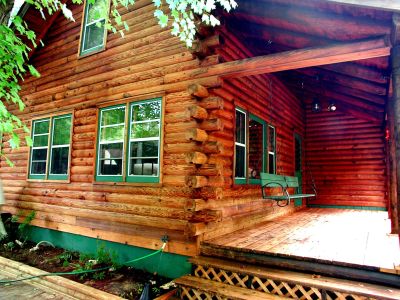
Log homes may be site-built or pre-cut in a factory for delivery to the site. Some log home manufacturers can also customize their designs. Before designing or purchasing a manufactured log home, you need to consider the following factors for energy efficiency.
Minimizing air leakage
Log homes are susceptible to developing air leaks. Air-dried logs are still about 15–20% water when the house is assembled or constructed. As the logs dry over the next few years, the logs shrink. The contraction and expansion of the logs open gaps between the logs, creating air leaks, which cause drafts and high heating requirements.
To minimize air leakage, logs should be seasoned (dried in a protected space) for at least six months before construction begins. These are the best woods to use to avoid this problem, in order of effectiveness:
Since most manufacturers and experienced builders know of these shrinkage and resulting air leakage problems, many will kiln dry the logs prior to finish shaping and installation. Some also recommend using plastic gaskets and caulking compounds to seal gaps. These seals require regular inspection and resealing when necessary. See also air sealing and log home air leakage and thermal imaging.
Controlling
moisture in log homes Since trees absorb large amounts of water as they grow, the tree cells are also able to absorb water very readily after the wood has dried. For this reason, a log home is very hygroscopic – it can absorb water quickly. This promotes wood rot and insect infestation.
It is strongly recommended that you protect the logs from any contact with any water or moisture. One moisture control method is to use only waterproofed and insecticide-treated logs. Reapply these treatments every few years for the life of the house.
Generous roof overhangs, properly sized gutters and downspouts, and drainage plains around the house are also critical for moisture control. See the general article on moisture control.
Building energy code compliance for log homes
Because log homes don't have conventional wood-stud walls and insulation, they often don't satisfy most building code energy standards – usually those involving required insulation R-values.
However, several states – including Pennsylvania, Maine, and South Carolina – have exempted log-walled homes from normal energy compliance regulations. Others, such as Washington, have approved "prescriptive packages" for various sizes of logs, but these may or may not make sense in terms of energy efficiency.
The American Society of Heating, Refrigerating, and Air Conditioning Engineers (ASHRAE) 90.2 standard contains a thermal mass provision that may make it easier to get approval in those states that base their codes on this standard.
To find out the log building code standards for your state, contact your city or county building code officials. Your state energy office may be able to provide information on energy codes recommended or enforced in your state.