
M38 (NGC 1912)
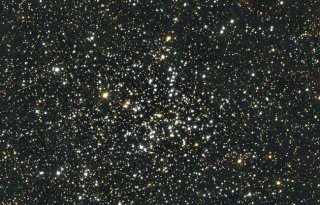
M38. Image credit: NOAO/AURA/NSF.
M38 (NGC 1912) is one of three bright open clusters in the southern part of the constellation Auriga, along with M36 (which lies 2.5° to the southeast) and M38. All three were first seen by Giovanni Hodierna before 1654. M38 was subsequently rediscovered by Guillaume Le Gentil in 1749 and included by Charles Messier in his catalog in 1764. All three clusters lie at similar distances of about 4,000 light-years.
M38 is considered an intermediately rich cluster (Trumpler class II,2,r) with an estimated age of 220 million years old. Located in the disk of our Milky Way galaxy, M38 is still young enough to house many bright blue stars, although it's brightest star is a yellow giant (mag 7.9 and spectral type G0) that is about 900 more luminous than the Sun.
| visual magnitude | 7.4 |
| angular size | 24' |
| linear diameter | 25 light-years |
| distance | 4,200 light-years (1,280 pc) |
| position | R.A. 05h 28m 43s , Dec. +35° 51.3' |
| other designations | C 0525+358, OCl 433.0 |

