
skylight operation and use
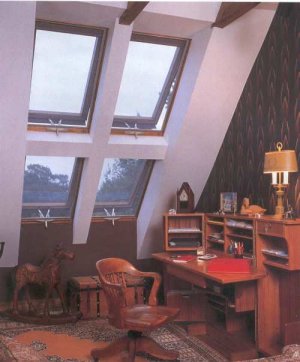
Some skylights operate to maximize a home's daylighting, and others provide ventilation and moisture control.
Daylighting
Recent high tech developments maximize skylights for daylighting. An "element" on the roof becomes an aperture for collecting sunlight. It may be a sun-tracking, open-sided cylinder; a large lens-like element; or merely a conventional skylight with a mirrored reflector mounted adjacent to it. This aperture may then connect to a mirrored pipe, or "light pipe," which has a diffusing lens that mounts on or is recessed into the ceiling of the room below. Most tubular skylights have this feature.
These skylight designs, relative to equivalent traditional skylights, effectively reduce daytime overheating and nighttime heat loss, but they do not provide views or ventilation.
Ventilation
Skylights can provide ventilation as well as light. Ventilating a building through a skylight opening releases the hot air that naturally accumulates near the ceiling. Ventilating skylights usually open outward at the bottom, some more than others. Some units vent through a small, hinged panel. One design uses a swing-down inner sash with a protected vent strip above. This can reduce the potential for rain or snow entering the room if the vents are open. Skylights may be opened manually with a pole, chain, or crank. Automated units with electric motors or pneumatic devices are also available. Some models incorporate moisture sensors to automatically close the skylight when it rains.
Larger skylights that can be used as doors are sometimes called "roof windows." Roof windows are always located within a few feet of the floor.
Moisture control
In very cold weather, skylights are often prone to water vapor condensing on the glazing. The accumulation of water may then drip into the room. Better skylights usually have an interior channel to collect the condensate so it can evaporate later. The most thermally efficient skylights are less prone to condensation problems.