
amphora
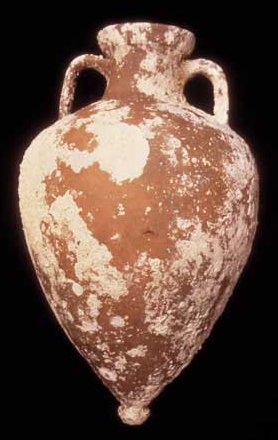
A Greek amphora recovered from the remains of a ship dating back to the 5th century BC found off the coast of Bulgaria. It is about one meter tall.
An amphora was a large clay vessel used by the ancient Greeks and Romans for holding and preserving various liquids, especially wine and oil, and also grain. An amphora had a narrow neck and two handles (in fact amphora means "two-handled"), and often ended in a sharp point below, for being inserted in a stand or in the ground. Some amphorae were decorated by the best-known vase painters.
Of the various subclasses, the Dipylon vases were geometrically decorated, the Panathenaic were decorated with a picture of Pallas Athene, the Nolan had long, slim necks, and the Campanian had twisted handles. Amphorae were fairly large. The Greek amphora contained about nine English gallons; the Roman, about six.
In Oriental art, the term is used for vase forms which resemble the Greek original. Amphorae were also used by the Incas; these had two handles near the bottom which facilitated carrying the vessel on the back.