
caulking
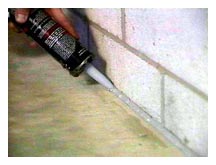
Caulk is a flexible material used to seal areas of potential air leakage into or out of a building envelope. Caulk forms a flexible seal for cracks, gaps, or joints less than 1-quarter-inch wide. You can use a caulking compound to seal air leaks in a variety of places throughout your home, including around windows and door frames.
In addition to sealing air leaks, caulking can also prevent water damage inside and outside of the home when applied around faucets, ceiling fixtures, water pipes, drains, bathtubs and other plumbing fixtures.
Before caulking any air leaks in an existing home, you need to do the following, if you haven't already:
Selection
Most caulking compounds come in disposable cartridges that fit in half-barrel caulking guns (if possible, purchase one with an automatic release). Some pressurized cartridges do not require caulking guns. When deciding how much caulking to purchase, consider that you'll probably need a half-cartridge per window or door and four cartridges for the foundation sill. Caulking compounds can also be found in aerosol cans, squeeze tubes, and ropes for small jobs or special applications.
Caulking compounds vary in strength, properties, and prices. Water-based caulk can be cleaned with water, while solvent-based compounds require a solvent for cleanup. See the table below for information about the types of common caulking compounds.
| Common caulking compounds | ||||||
|---|---|---|---|---|---|---|
| Caulking compound | Recommended uses | Cleanup | Shrinkage | Adhesion | Cost | Comments |
| Silicone: Household | Seals joints between bath and kitchen fixtures and tile. Forms adhesive for tiles and metal fixtures. Seals metal joints as in plumbing and gutters | Dry cloth if immediate; mineral spirits or naphtha | Little or none | Good to excellent | High | Flexible: cured silicone allows stretch of joints up to three times normal width or compression to one-half the width |
| Silicone: Construction | Seals most dissimilar building materials such as wood and stone, metal flashing, and brick | Dry cloth if immediate; mineral spirits or naphtha | Little or none | Good to excellent | High | Permits joints to stretch or compress. Silicones will stick to painted surfaces, but paint will not adhere to most cured silicones |
| Polyurethane, expandable spray foam | Expands when curing; good for larger cracks indoors or outdoors. Use in nonfriction areas, as rubber becomes dry and powdery over time | Solvent such as lacquer thinner, if immediate | None; expands quite a bit | Good to excellent | Moderate to high | Spray-foam quickly expands to fit larger, irregular-shaped gaps. Flexible. Can be applied at variable temperatures. Must be painted for exterior use to protect from ultraviolet radiation. Manufacturing process produces greenhouse gases |
| Water-based foam sealant | Around window and door frames in new construction; smaller cracks | Water | None; expands only 25% | Good to excellent | High | Takes 24 hours to cure. Cures to soft consistency. Water-based foam production does not produce greenhouse gases. Will not over-expand to bend windows (new construction). Must be exposed to air to dry. Not useful for larger gaps, as curing becomes difficult |
| Butyl rubber | Seals most dissimilar materials (glass, metal, plastic, wood, and concrete.) Seals around windows and flashing, bonds loose shingles | Mineral spirits or naphtha | From 5% to 30% | Good | Moderate to high | Durable 10 or more years; resilient, not brittle. Can be painted after one week curing. Variable shrinkage; may require two applications. Does not adhere well to painted surfaces. Toxic; follow label precautions |
| Latex | Seals joints around tub and shower. Fills cracks in tile, plaster, glass, and plastic; fills nail holes | Water | From 5% to 10% | Good to excellent | Moderate | Easy to use. Seams can be trimmed or smoothed with moist finger or tool. Water resistant when dry. Can be sanded and painted. Less elastic than above materials. Varied durability, 2–10 years. Will not adhere to metal. Little flexibility once cured. Needs to be painted when used on exteriors |
| Oil or resin-based | Seals exterior seams and joints on building materials | Mineral spirits or naphtha | From 10% to 20% | Good | Low | Readily available. Least expensive of the four types. Rope and tube form available. Oils dry out and cause material to harden and fall out. Low durability, 1–4 years. Poor adhesion to porous surfaces like masonry. Should be painted. Can be toxic (check label). Limited temperature range |
Application
Although not a high-tech operation, caulking can be tricky. Read and follow the instructions on the compound cartridge. Save yourself some trouble by remembering a few important tips:
Don't skimp. If the caulk shrinks, reapply it to form a smooth bead that will seal the crack completely.
Before applying new caulk, remove old caulk or paint residue remaining around a window using a putty knife, stiff brush, or special solvent. After old caulk is removed, new caulk can then be applied to all joints in the window frame and the joint between the frame and the wall. The best time to apply caulk is during dry weather when the outdoor temperature is above 45°F (7.2°C). Low humidity is important during application to prevent cracks from swelling with moisture. Warm temperatures are also necessary so the caulk will set properly and adhere to the surface.