
drill

An electric drill as used for light construction
work in the home. This versatile tool employs a universal motor, offering
high torque at low speeds and reduced torque at high speeds, coupled
through a two-speed transmission to the chuck assembly. As shown here
the gears are set for low-speed running. Electrical safety is ensured
through double insulation.
(Bottom left) Types of drill bit include: (a) twist drill
(for metal, plastic, wood, etc.); (b) masonry bit; (c) auger bit (for
wood); (d) high-speed wood bit.
The jaws of most domestic electric drills will also accept accessories
other than drill bits. Rotary wire brushes, polishing pads, grinding
wheels, sanding disks, files, and cutting heads are common examples.
Alternatively, the whole chuck assembly can be removed and the drill
become a power source for a circular saw blade.
A drill is a tool for cutting or enlarging holes in hard materials. There are two classes of drills: those that have a rotary action, with a cutting edge or edges at the point and, usually, helical fluting along the shank; and those that work by percussive action, where repeated blows drive the drill into the material. These two types are discussed in more detail below.
Rotary drills
Rotary drills are commonly used in the home for wood, plastic, masonry, and sometimes metal. They were hand turned, but now electric drills are used for many applications. In metallurgy, the mechanical drilling machine or drill press is one of the most important machine tools, operating one or several drills at a time. As a lot of heat is generated, lubrication is very important. Most metallurgical drills are made of high-grade steel. Dentists' drills rotate at extremely high speeds, their tips (of tungsten carbide or diamond) being water-cooled; they are powered by an electric motor or by compressed air. Rotary drills are used for deeper oil-well drilling: a cutting bit is rotated at the end of a long, hollow drill pipe, new sections of pipe being added as drilling proceeds.
Auger
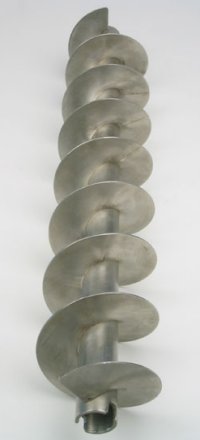 |
An auger is a tool used for boring holes in wood, earth, ice, or other material, or more generally, for moving material along a large corkscrew. A hand-held auger is T-shaped and is gripped by the handle with both hands. By contrast, a gimlet, like a wine bottle corkscrew, is worked with just one hand.
Percussive drills
Percussive drills are used for rock-boring, for concrete and masonry, and for shallower oil-well drilling. Rock drills are generally powered by compressed air, the tool rotating after each blow to increase cutting speed. The pneumatic drill familiar in city streets is also operated by compressed air. Ultrasonic drills are used for brittle materials; a rod, attached to a transducer, is placed against the surface, and to it are fed abrasive particles suspended in a cooling fluid. It is these particles that actually perform the cutting.
See also rotary hammer drill.