
green roof
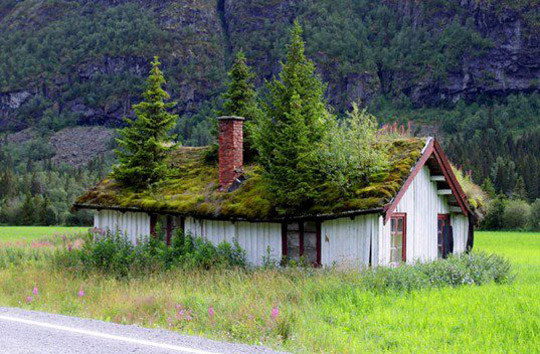
A green roof on a house in Norway.
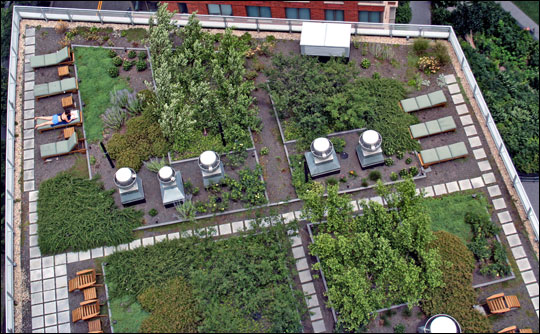
The garden-like green roof atop the Solaire in Battery Park City in New York. Photo © birdworks/Simon Bird and the Albanese Organization.
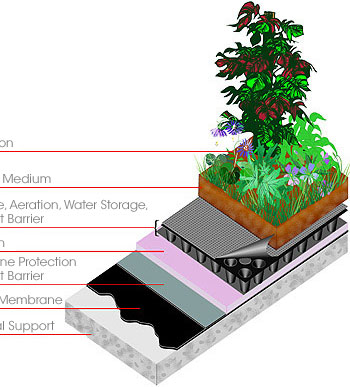
Although longer-lived than a standard roof, a vegetation-covered roof is more complex, and its components mitigate both urban heat and urban runoff. Water that would otherwise reach a storm sewer is trapped by the green roof's soil and vegetation. Image © American Wick Drain Corporation.
A green roof is a vegetation-covered roof that can range in complexity from a shallow layer of soil and plants to a more elaborate rooftop garden with trees and shrubs. The more elaborate roofs place greater structural loads on buildings and require more maintenance, so planning and implementing them is more complicated.
Advantages of green roofs
Research from around the world indicates that green roofs reduce annual run-off from roofs by at least 50%, and more usually by 60-70% – contributing to urban drainage and flood alleviation schemes. Moreover, the rate of release following heavy rainfall is slowed, reducing the problems associated with storm surges.
Green roofs (and other practices such as natural ventilation) reduce the need for air conditioning in the summer and as a result reduce carbon dioxide emissions.
Whereas new developments often lead to a loss of habitats, green roofs can contribute to biodiversity and address local biodiversity action plans. In particular they have been shown to favor many rare invertebrates found on brownfield sites, as well as ground-nesting birds such as skylarks.
Green roofs contribute to a greener urban environment and quality of life for communities in high density developments.
A roof life is at least doubled with the addition of a green roof, thereby reducing resource use in roof replacement and repair.
Make-up of a typical green roof
A typical green roof may include the following layers: a waterproof membrane at the bottom, a layer of drainage materials, a root-repellant and filter layer, a lightweight soil-like growing medium, and finally the plants.
Compared to standard roofs, green roofs have more mass, but thin systems of only 7.5 to 10 centimeters (3 to 4 inches) are sufficient. When they are saturated with rainwater, they may create a load of 1,197 pascals (about 25 pounds per square foot), which is often feasible for many city buildings. By evaporating moisture, the plants release heat without raising local temperatures. Likewise, the plants and soil soak up rainfall like a sponge instead of letting it roll right off the surface.