
grid-connected system metering
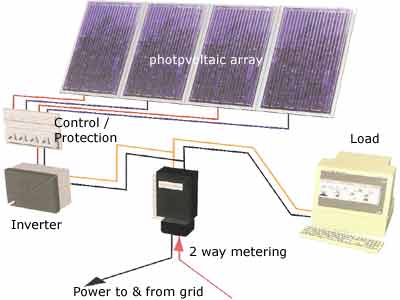
The Public Utility Regulatory Policy Act of 1978 (PURPA) requires power providers to purchase excess power from grid-connected small renewable energy systems at a rate equal to what it costs the power provider to produce the power itself. Power providers generally implement this requirement through various metering arrangements. Here are the metering arrangements you are likely to encounter:
Net purchase and sale
Under this arrangement, two unidirectional meters are installed – one records electricity drawn from the grid, and the other records excess electricity generated and fed back into the grid. You pay retail rate for the electricity you use, and the power provider purchases your excess generation at its avoided cost (wholesale rate). There may be a significant difference between the retail rate you pay and the power provider's avoided cost.Net metering
Net metering provides the greatest benefit to you as a consumer. Under this arrangement, a single, bidirectional meter is used to record both electricity you draw from the grid and the excess electricity your system feeds back into the grid. The meter spins forward as you draw electricity, and it spins backward as the excess is fed into the grid. If, at the end of the month, you've used more electricity than your system has produced, you pay retail price for that extra electricity. If you've produced more than you've used, the power provider generally pays you for the extra electricity at its avoided cost. The real benefit of net metering is that the power provider essentially pays you retail price for the electricity you feed back into the grid.
Some power providers will now let you carry over the balance of any net extra electricity your system generates from month to month, which can be an advantage if the resource you are using to generate your electricity is seasonal. If, at the end of the year, you have produced more than you've used, you forfeit the excess generation to the power provider.