
heat pump
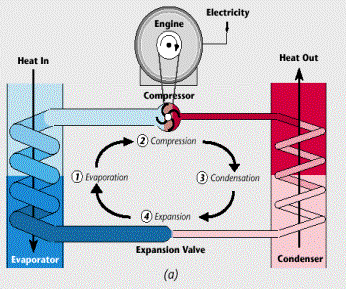
Basic principles of a heat pump.
Principle of the heat pump
Heat naturally flows from hot places to cold places. However, heat can be moved in the other direction, from cold to hot, with a heat pump (just as water can be moved uphill by a water pump), a device usually driven by an electric motor. Air conditioners transfer heat from a cool house to the hot out- doors, so in a strict sense, they are heat pumps.
A heat pump is basically an air conditioner with a valve that allows it to operate in reverse. It extracts available heat from one area (the heat source) and transfers it to another (the heat sink) to either heat or cool an interior space or to extract heat energy from a fluid. In the case of a fridge, for example, heat is transferred from the interior of the fridge to the condenser coils at the back.
For climates with moderate heating and cooling needs, heat pumps offer an energy-efficient alternative to furnaces and air conditioners. Like a refrigerator, a heat pump uses electricity to move heat from a cool space into a warm one, making the cool space cooler and the warm space warmer. During the heating season, heat pumps move heat from the cool outdoors into your warm house; during the cooling season, heat pumps move heat from your cool house into the warm outdoors. Because they move heat rather than generate heat, heat pumps can provide up to 4 times the amount of energy they consume.
Types of heat pump
The most common type of heat pump is the air-source heat pump, which transfers heat between the interior of a building and the outside air. If you heat with electricity, a heat pump can trim the amount of electricity you use for heating by as much as 30–40%. High-efficiency heat pumps also dehumidify better than standard central air conditioners, resulting in less energy usage and more cooling comfort in summer months. However, the efficiency of most air-source heat pumps as a heat source drops dramatically at low temperatures, generally making them unsuitable for cold climates, although there are systems that can overcome that problem. One such system is the dual-fuel heat pump.
For homes without ducts, air-source heat pumps are also available in a ductless version called a mini-split heat pump. In addition, a special type of air-source heat pump called a "reverse cycle chiller" generates hot and cold water rather than air, allowing it to be used with radiant floor heating systems in heating mode.
Higher efficiencies are achieved with geothermal heat pumps (ground-source or water-source), which transfer heat between your house and the ground or a nearby water source. Although they are more costly to install, geothermal heat pumps have low operating costs because they take advantage of relatively constant ground or water temperatures. However, the installation depends on the size of your lot, the subsoil, and the landscape. Ground-source or water-source heat pumps can be used in more extreme climatic conditions than air-source heat pumps, and customer satisfaction with the systems is very high.
A new type of heat pump for residential systems is the absorption heat pump, also called a gas-fired heat pump. Absorption heat pumps use heat as their energy source, and can be driven with a wide variety of heat sources.
Efficiency and economics of heat pumps
A heat pump will generally use less than half the energy required by an electric resistance furnace, so it not only saves money, it also reduces emissions from fossil fuel power plants. In terms of emissions and fossil fuel consumption, it can actually surpass the performance of burning natural gas directly.
Compared to a standard air-source heat pump, ground coupling adds another level of efficiency. But this is partially offset by the energy required to circulate the antifreeze solution, and, the initial cost of a ground-coupled unit is higher. Therefore a cost analysis should be done to determine the lifetime energy savings as balanced against the higher initial cost.
Manufacturers of ground-source heat pumps claim annual heating cost reductions of up to 50% and annual air conditioning cost reductions of up to 25%. The amount actually saved will depend on the local climate and particular installation. Heating season savings will be more significant in colder climates, where air-source heat pumps are less effective because of the cold air temperatures. Cooling season savings will likewise be greater in the hotter climates.
More about heat pumps
• Choosing a heat pump
• Advanced features to look for in a heat pump
• Operating and maintaining a heat pump