
insolation
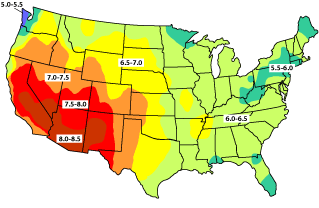
Although the quantity of solar radiation striking the Earth varies by region, season, time of day, climate, and air pollution, the yearly amount of energy striking almost any part of the Earth is vast. Shown is the average radiation received on a horizontal surface across the continental United States in the month of June. Units are in kWh/m2.
Insolation is the amount of solar energy, direct or diffuse, reaching a surface per unit of time. More precisely, insolation is the solar power density incident on a surface of stated area and orientation, usually expressed as watts per square meter (W/m2) or BTU per square foot per hour. The word is a contraction of "incident solar radiation;" not to be confused with insulation. Compare with irradiance.
Insolation values for a specific site are sometimes difficult to obtain. Weather stations that measure solar radiation components are located far apart and may not carry specific insolation data for a given site. Furthermore, the information most generally available is the average daily total – or global – radiation on a horizontal surface. To learn more about solar and other resource data, visit the external sites listed below.
When sunlight reaches the Earth, it is distributed unevenly in different regions. Not surprisingly, the areas near the equator receive more solar radiation than anywhere else on Earth. Sunlight varies with the seasons, as Earth's rotational axis shifts to lengthen and shorten days with the changing seasons. For example, the amount of solar energy falling per square meter on Yuma, Arizona, in June is typically about nine times greater than that falling on Caribou, Maine, in December. The quantity of sunlight reaching any region is also affected by the time of day, the climate (especially the cloud cover, which scatters the sun's rays), and the air pollution in that region. Likewise, these climatic factors all affect the amount of solar energy that is available to photovoltaic systems.