ABOUT | CATEGORIES | Worlds of David Darling | CONTACT
A · B · C · D · E · F · G · H · I · J · K · L · M · N · O · P · Q · R · S · T · U · V · W · X · Y · Z

alternative energy and sustainable living


  entire Web this site


roof overhang

roof overhang


In passive solar home design, exterior roof overhangs provide a practical method for shading building elements such as windows, doors, and walls.


How roof overhangs work

Overhangs are most effective for south facing elements (in the northern hemisphere) and at midday. If the building element bears more than about 30° off true south, the effectiveness of an overhang, as with any solar feature, begins to decrease significantly. Overhangs usually only affect the amount of direct solar radiation that strikes a surface. Diffuse sky and reflected radiation gains are not often directly affected by overhangs.

The higher overhead the sun is, the shorter the shadow a person will cast on the ground. However, the short brim of a baseball cap can create a long shadow across the body of a standing person. The same concept applies in designing overhangs for buildings. The higher, or more vertical, the arc of the sun, the longer the shadow that the building overhang generates along the face of the wall. Summer shadows extend down walls the furthest, winter shadows the least. Sites closer to the equatorial path of the sun have deeper-extending wall shadows than ones farther from the equator, assuming the same overhang length.


Types of overhangs

Overhangs may be solid, louvered, vegetation-supporting, or a combination of all of these aspects. Some shutters, eaves, trellises, light shelves, and awnings serve the same purpose as an overhang.

Overhangs may also be fixed, operable, and/or removable. Examples include roof eaves, awnings, and Bahama shutters (top-hinged louvered shutters typically propped open with wooden dowels) respectively. Fixed overhangs offer perceived longevity and low maintenance at the expense of flexibility or the ability to adjust to site-specific factors. Although adjustable devices allow the user to fine tune the amount of shade or direct sunlight, they require more maintenance. Removable fixtures generally provide flexibility and longevity plus some personal involvement with installation and removal.

Openings, such as windows, do not always require fixed overhangs. A fixed overhang designed for optimal shading on the autumnal equinox (September 21) casts the same shadow on the vernal equinox (March 21). While northern-hemisphere shading may be welcome in September because of the heat, shading in March may be undesirable. Vegetation, on the other hand, can follow the climatic seasons. Vines that shed their leaves for winter usually leaf out about the time shading is needed. Movable shading devices, while adjustable, often become maintenance problems.
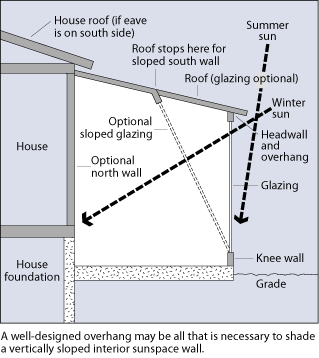

roof overhang
A well-designed overhang may be all that is necessary to shade a vertically sloped interior sunspace wall


Sizing overhangs

SOLAR ENERGY PAGES ON THIS SITE

  • absorber
  • absorption coefficient
  • absorptivity
  • active solar energy system
  • active solar heating system
  • air-based collector
  • amorphous photovoltaic cell
  • annual solar savings
  • angle of incidence
  • angle of inclination
  • aperture
  • apparent day
  • autonomous system
  • azimuth

  • back-pass solar collector
  • batch solar collector
  • beam radiation
  • blackbody
  • blocking diode
  • briefcase solar panels
  • buffer storage
  • building-integrated PV
  • bypass diode

  • candela
  • candle power
  • collector efficiency
  • collector fluid
  • collector tilt
  • community solar access
  • compound paraboloid collector
  • concentrating collector
  • concentrator
  • crystalline silicon photovoltaic cell
  • current at maximum power

  • declination
  • differential thermostat
  • diffuse insolation
  • diffuse radiation
  • direct beam radiation
  • direct gain
  • direct insolation
  • direct solar water heater
  • double wall heat exchanger

  • elevation
  • emissivity
  • equinox
  • ethylene vinyl acetate
  • eutectic salts
  • evacuated tube collector
  • expansion tank

  • fill factor
  • flat plate photovoltaic
  • flat plate pumped collector
  • flat plate solar module
  • flat plate solar thermal collector
  • flow condition
  • foot candle
  • Fresnel lens
  • full sun

  • Glauber's salt
  • global insolation
  • ground reflection

  • heat absorbing window glass
  • heliochemical process
  • heliodon
  • heliostat
  • heliothermal
  • heliothermic
  • heliothermometer
  • heliotropic
  • hemispherical bowl technology
  • high-temperature collector
  • hot spot

  • I-V curve
  • illuminance
  • incident light
  • incident solar radiation
  • indirect solar gain system
  • indirect solar water heater
  • infrared radiation
  • insolation
  • instantaneous efficiency
  • interconnect
  • internal collector storage
  • irradiance
  • isolated solar gain system
  • isolation diode

  • junction box

  • light-induced defect
  • light trapping
  • liquid-based active solar heating
  • liquid-based solar collector
  • local solar time
  • low-flow solar water heating system
  • low-temperature collector
  • low emissivity glass
  • lumen

  • maximum power point
  • maximum power point tracker
  • medium-temperature collector
  • mixing valve
  • multijunction device

  • normal operating cell temperature

  • one sun
  • orientation
  • ovonic

  • parabolic dish collector
  • parabolic trough collector
  • passive solar design
  • passive solar energy
  • passive solar heater
  • passive solar heating
  • peak sun hours
  • performance rating
  • photocurrent
  • photoelectric cell
  • photoelectrochemical cell
  • photogalvanic process
  • photon
  • photosynthesis
  • photovoltaic
  • photovoltaic cell
  • photovoltaic conversion
  • photovoltaic device
  • photovoltaic efficiency
  • photovoltaic generator
  • photovoltaic peak watt
  • photovoltaic system
  • photovoltaic thermal system
  • power tower
  • preheater
  • projected area
  • pyroheliometer
  • pyronometer

  • recirculation system
  • reflective coatings
  • reflective glass
  • reflective window film
  • reverse bias
  • reverse thermosiphoning
  • ribbon cell
  • rock bin
  • roof-mounted solar power system
  • roof pond

  • salt gradient solar pond
  • selective absorber
  • selective surface coating
  • shading coefficient
  • smart window
  • solar air heater
  • solar altitude angle
  • solar architecture
  • solar array
  • solar azimuth
  • solar building
  • solar cell
  • solar charge controller
  • solar chimney power station
  • solar collector
  • solar collector orientation and tilt
  • solar constant
  • solar cooker
  • solar cooling
  • solar day
  • solar declination
  • solar distillation
  • solar electric system
  • solar electricity site resource eval.
  • solar energy
  • solar energy for crop drying
  • solar film
  • solar fraction
  • solar furnace
  • solar gain
  • solar heat gain coefficient
  • solar heating
  • solar heating for homes & buildings
  • solar heating system
  • solar hot water for agriculture
  • solar hot water for aquaculture
  • solar hot water system
  • solar irradiation
  • solar mass
  • solar module
  • solar noon
  • Solar One
  • solar oven
  • solar panel
  • solar photovoltaic device
  • solar pond
  • solar power system
  • solar radiation
  • solar simulator
  • solar space heater
  • solar spectrum
  • solar swimming pool heating
  • solar thermal electric system
  • solar thermal parabolic dish
  • solar thermal system
  • solar time
  • solar transmittance
  • solar trough system
  • Solar Two
  • solar ventilation air heating
  • solar voltaic device
  • solar water heater cost estimation
  • solar water heater economics
  • solar water heater efficiency
  • solar water heater freeze protection
  • solar water heater maint. & repair
  • solar water heater site resource eval.
  • solar water heater sizing
  • solar water heating system corrosion
  • solar water heating sys. bldng codes
  • solarium
  • solar-grade silicon
  • solar-powered vehicle
  • solstice
  • spectral energy distribution
  • spectral irradiance
  • spectral reflectance
  • spectrally selective coating
  • split-spectrum cell
  • Staebler-Wronski effect
  • stagnation temperature
  • stand-off mounting
  • standard operating conditions
  • standard test conditions
  • stationary concentarting collector
  • sun path diagram
  • sun tempered building
  • sunspace
  • swimming pool absorber

  • temperature coefficient
  • thermal storage wall
  • thermo photovoltaic (TPV) device
  • thermophotovoltaic cell
  • thermosiphon
  • thermosiphon system
  • thin film cell
  • tilt angle of a solar collector
  • total incident radiation
  • total internal reflection
  • tracking array
  • trickle (solar) collector
  • Trombe wall
  • true south
  • tube-in-plate absorber
  • tube-type collector
  • two-axis tracking
  • two-tank solar system

  • ultraviolet
  • unglazed perforated plate collector
  • unglazed solar collector

  • visible light transmittance
  • visible radiation

  • water wall
  • Unfortunately, there is as yet no universally simple formula for sizing overhangs. While one overhang methodology works well for some locations, it can be completely inappropriate for others. For example, there are a limited number of overhang-sizing guidelines acceptable for buildings located in southern states, particularly hot-humid climates. Guidelines acceptable for the high plains of Montana are unlikely to work for a site in Florida.

    Due to the varying microclimate conditions encountered across the United States, the methods presented here are general in scope. Anyone seeking a more specialized analysis should seek professional advice from an architect trained in passive solar design.

    Every climate requires special design attention. The following general guidelines may be useful in determining a suitable overhang design. The guidelines are listed by climate type, for solar noon, when the sun reaches its maximum altitude for a given day. Solar noon is very rarely the same as noon in local standard time.
    • Cold climates: above 6,000 heating degree days (HDD)* (at base 65°F (18°C))
      Locate shadow line at mid-window using the June 21 (summer solstice) sun angle.

    • Moderate climates: below 6,000 heating degree days (HDD)* (at base 65°F (18°C)) and below 2,600 cooling degree days (CDD)* (at base 75°F (22°C))
      Locate shadow line at window sill using the June 21 (summer solstice) sun angle.

    • Hot climates: above 2,600 cooling degree days (CDD)* (base 75°F (22°C))
      Locate shadow line at window sill using the March 21 (vernal equinox) sun angle.
    *(HDD and CDD data is available from local weather services.)


    Overhangs and zoning ordinances

    Overhangs may be inappropriate for sites with restrictive regulatory guidelines. For example, your calculations indicate your house needs a three foot (~1 meter) overhang on the front. The local zoning ordinance restricts eave extension to two feet (0.61 m) beyond the front yard setback. If your house will be or is located precisely on the setback, you must do one of following: relocate your house at least one foot (0.3 mm) back from the front building setback; redesign your building fenestration (windows, doors, grilles, vents, and other openings); redesign your overhang; or apply for a variance (an exception to the ordinance).


    Related categories

       • SOLAR ENERGY AND POWER
       • ROOFS AND ROOFING MATERIALS


    Source: US Department of Energy


    Also on this site:

    Encyclopedia of Science
    Transport Concepts & Designs (partner site)


    BACK TO TOP