
slab-on-grade foundation insulation
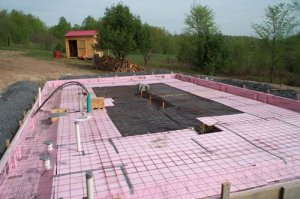
Properly insulating your slab-on-grade floors not only will help you save on energy bills, but also will improve your home's comfort. Cold concrete slabs can be a source of discomfort in a home. An insulated slab reduces heat loss, making it easier to heat. This reduction in heat loss helps moderate indoor temperatures.
Annual energy savings and payback
Slabs lose energy primarily as a result of heat conducted outward and through the perimeter of the slab. Therefore, in most parts of the United States, insulating the exterior edge of the slab can reduce heating bills by 10-20%. In climates with mild winters, slab insulation in a typical 1,800 square-foot home would save $50-60 annually. Slab insulation with an R-value of R-10 for an 1,800 square-foot home typically could cost $300-600 to install. Thus, the insulation would pay for itself in 5 to 10 years.
The investment in slab insulation is also economical as part of a mortgage. An insulation cost of $450 would add about $38 to the annual mortgage. However, the insulation would save over $50 annually in energy bills. Therefore, the savings exceed the additional mortgage cost from the beginning, resulting in an immediate payback.
Determining insulation R-Value and depth
The International Energy Conservation Code Council (IECC) specifies both the R-value and minimum distance for the insulation from the top of the slab downward based on a locality's heating degree days (HDDs). Consult your local weather bureau for your area's actual heating degree days. Then use the table below to find the IECC's recommended depth and R-value based on your heating degree days.
| Recommended R-values and depth for slab insulation | ||
|---|---|---|
| Heating degree days | Feet installed vertically | R-value |
| 0 to 2,499 | none required | none required |
| 2,499 to 4,500 | 2 feet | R-4 |
| 4,500 to 6,000 | 4 feet | R-5 |
| 6,000 to 7,200 | 4 feet | R-6 |
| 7,200 to 8,700 | 4 feet | R-7 |
| 8,700 to 10,000 | 4 feet | R-8 |
| 10,000 to 12,400 | 4 feet | R-9 |
| 12,400 to 14,000 | 4 feet | R-10 |
Select and install insulation using these recommendations. Be sure to use only insulation approved for below-grade use.
Insulation techniques
Slab insulation can be installed using one of two basic techniques:
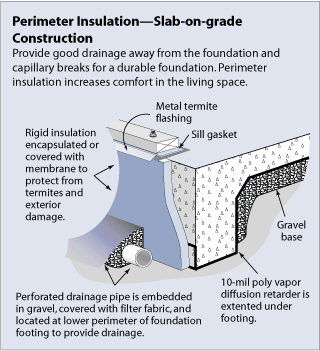
If insulation is installed on the exterior of the slab:
 |
Other considerations
When installing a slab foundation and insulating it, it's also important to consider moisture and air leakage control, as well as termite control.
Termites can tunnel undetected through exterior slab insulation to gain access to the wood framing in a home's walls. As a result, some insurance companies won't guarantee homes with slab insulation against termites. Building codes in several southern U.S. states prohibit installing foam insulation in contact with the ground.
"Floating" slab foundations with interior insulation provide more termite resistance. However, some builders in the southeastern United States have reported termite infestations through foam insulation on contained slabs.
To help offset termite problems, follow these guidelines:
You'll also want to regularly inspect for termites. If you use a pest control company, obtain a good warranty for its work. Finally, you need to consider radon resistance or control when installing slab-on-grade foundations.