
small wind electric system resource evaluation

Small wind turbine.
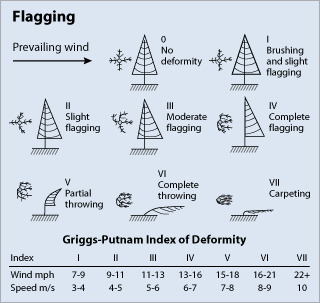
Illustrations and a Griggs-Putnam Index of Deformity chart that show how to use flagging to evaluate a site's wind resource. The first figure shows a pine tree with no deformity from the wind. The second, I on the chart index, shows a pine tree brushed by the wind, indicating brushing and slight flagging. The chart shows a wind resource of 7-9 miles per hour (mph) at a speed of 3-4 meters per second (m/s). The third tree (II) is bending from the wind, indicating slight flagging. The wind resource is 9-11 mph at a speed of 4-5 m/s. The fourth tree (III) is bending more than in the third, indicating moderate flagging. The wind resource is 11-13 mph at a speed of 5-6 m/s. The fifth figure (IV) shows half the pine tree missing, indicating complete flagging. The wind resource is 13-16 mph at a speed of 6-7 m/s. The sixth figure (V) shows half of a pine tree missing. The tree is bending over from the wind, indicating partial throwing. The wind resource is 15-18 mph at a speed of 7-8 m/s. The seventh figure (VI) shows half of a pine tree bending almost completely over from the wind, indicating complete throwing. The wind resource is 16-21 mph at a speed of 8-9 m/s. The eighth figure (VII) shows a pine tree lying flat from the wind, indicating carpeting. The wind resource is 22+ mph at a speed of 10 m/s.
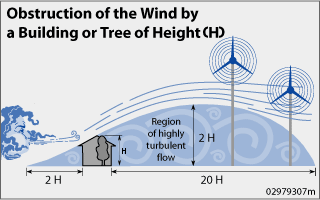
An illustration showing a house and tree obstructing the wind, indicating the possible need to site a wind turbine away from any impact from these obstructions and/or a taller wind turbine. The wind blows over the house and tree, and then reaches two wind turbines, spinning each turbine's three blades. The turbine on the left is taller than the one on its right. In between the house and tree, and the turbines, an area called a 'region of highly turbulent flow' is indicated.
To help determine the suitability of your site for a small electric wind system, you need to estimate your site's wind resource. The wind resource can vary significantly over an area of just a few miles because of local terrain influences on the wind flow. You can use the following methods for estimating your wind resource.
Consult wind resource maps
As a first step, you can consult a wind resource map, which is used to estimate the wind resource in your area. The U.S. Department of Energy's Wind Powering America Program has wind resource maps by state.
Obtain airport wind speed data
Another way to indirectly quantify the wind resource is to obtain average wind speed information from a nearby airport. However, local terrain influences and other factors may cause the wind speed recorded at an airport to be different from your particular location. Airport wind data are generally measured at heights about 20–33 feet (6–10 meters) aboveground. Average wind speeds increase with height and may be 15–25% greater at a typical wind turbine hub-height of 80 feet (24 meters) than those measured at airport anemometer heights.
Observe vegetation flagging
Flagging – the effect of strong winds on area vegetation – can help determine area wind speeds. Trees, especially conifers or evergreens, can be permanently deformed by strong winds.
Use a measurement system
Direct monitoring by a wind resource measurement system at a site provides the clearest picture of the available resource. Wind measurement systems are available for costs as low as $600–$1,200.
The measurement equipment must be set high enough to avoid turbulence created by trees, buildings, and other obstructions. The most useful readings are those taken at hub-height, the elevation at the top of the tower where the wind turbine is going to be installed.
Obtain data from a local small wind system
If there is a small wind turbine system in your area, you may be able to obtain information on the annual output of the system and also wind speed data if available.