
Aeneas
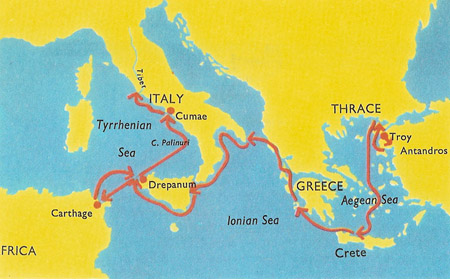
The journeys of Aeneas and his companions.
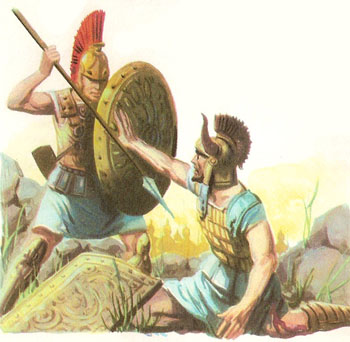
Aeneas overcomes his rival Turnus in a hand-to-hand fight.
In Roman legend, Aeneas was the ancestor of the Romans. Aeneas was a Trojan hero, the son of Anchises and Venus, who escaped after the fall of Troy, bearing his father on his shoulders. After wandering through the Mediterranean, he reached Italy at Cumae and visited the Underworld, where the destiny of Rome was made clear to him. He married the daughter of the King of Latium, and allied himself to the Latins in local wars. His son founded Alba Longa, and a line of kings from which Romulus was said to be descended.
The latest and most complete account of the travels and adventures of Aeneas is to be found in Virgil's Aeneid. Virgil was one of the greatest Roman poets, who wrote at the beginning of the Roman Empire, in about 30 BC. Although the Aeneid was intended as a great epic poem, it also had a deeper purpose. Augustus, the first Roman Emperor, wanted his citizens to take pride in their glorious past; he therefore commissioned Virgil to write a poem on the subject of the origins of Rome. Virgil, however, chose not to write about Romulus and Remus, the legendary founders of the city of Rome; instead, he went even further back, to the Trojan War (traditionally believed to be about 1180 BC. Virgil thus linked the origins of Rome with Greece, a country which the Romans greatly admired. Although Aeneas is a legendary figure, the Aeneid is of considerable interest to us, because it gives a good idea of what the Romans thought about their early history. It is also very fine poetry.
Seven years' wandering
Virgil is believed to have deliberately based the Aeneid on two famous Greek originals: the Odyssey, which describes the wanderings of Ulysses after the fall of Troy, and the Iliad, which describes the fighting at Troy. The first six books of the Aeneid, which tell of Aeneas' seven years wandering over the seas in order to reach Italy, are modeled on the first half of the Odyssey. The last six books, which tell the story of the war with the Rutuli, are modeled on the Iliad.
The story is that when Troy was sacked, Aeneas managed to rescue from the flames his aged father Anchises, his young son Ascanius, and his household gods. He sought temporary refuge, together with a number of his followers, on Mount Ida, a hill overlooking Troy. The small band then went to Antandros, where they built a fleet of ships. They finally set sail, landing first at Thrace, where they started to found a city. But omens of various kinds warned Aeneas that it was his destiny to establish a new race elsewhere, and he and his men set sail again, this time for Crete. There, Aeneas learned that Italy was his fated destination, and they set off once more. On the island of Strophades they were attacked by strange birds with the heads of women, called harpies, who seized their food and prevented them from eating. The harpies' leader prophesied that they would not found a city until they were forced by hunger to eat the tables on which their food was placed.
The band continued its journey to Italy, but they had only got as far as Sicily when they were driven by a fierce storm to Carthage on the African coast. There, the queen Dido, who was building a new city, fell in love with Aeneas and begged him to stay and help her in her task. Aeneas at first agreed, but after a dream in which Mercury, the messenger of the gods, warned him to go on, he departed secretly with his companions. Dido killed herself in her despair at being deserted.
Arrival at last
They first landed in Italy at Cumae, said to be one of the entrances to the underworld. Aeneas, having plucked the golden bough, descended into the nether regions with the prophetess Sibyl and was shown the future glory of the nation he was to found. He also saw Dido's ghost, but she refused to speak to him. The next landfall was at the mouth of the river Tiber. Here the band disembarked and had a meal, during which they ate the wheaten cakes on which they had placed their food. Greatly encouraged by the fact that the harpy's prophecy had been fulfilled, they began to search the countryside. It transpired that this country was Latium, and that a prophecy had foretold that Lavinia, the daughter of its ruler Latinus, would marry a foreigner. Latinus realized that Aeneas was the promised stranger and offered him Lavinia as his wide.
However, Turnus, king of the neighboring Rutuli, had long been determined to marry Lavinia himself. When he saw his ambition being thwarted he declared war on Aeneas. After much fighting, Turnus challenged Aeneas to single combat in order to decide which of them should marry Lavinia and rule the country. Aeneas promised that his men would leave the country if he was defeated and killed, while if he won he would form an alliance with the Latins. Watched by their armies, the two heroes met and fought in deadly silence. Although Aeneas had the worst of the fight to start with, he eventually broke Turnus's sword and defeated him.
The founding of Rome
Having won the duel and married Lavinia, Aeneas was thus able to fulfil his destiny and found the Roman race. Four centuries later, his descendant Romulus founded the city of Rome itself. Virgil thus skillfully combined two different legends about the foundation of Rome into one great poem.