
aqueduct
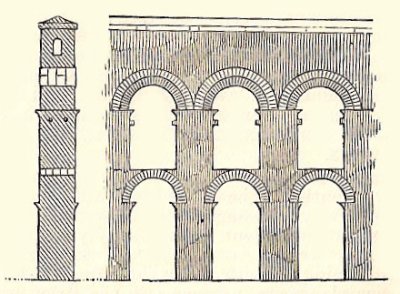
Aqua Alexandrina.
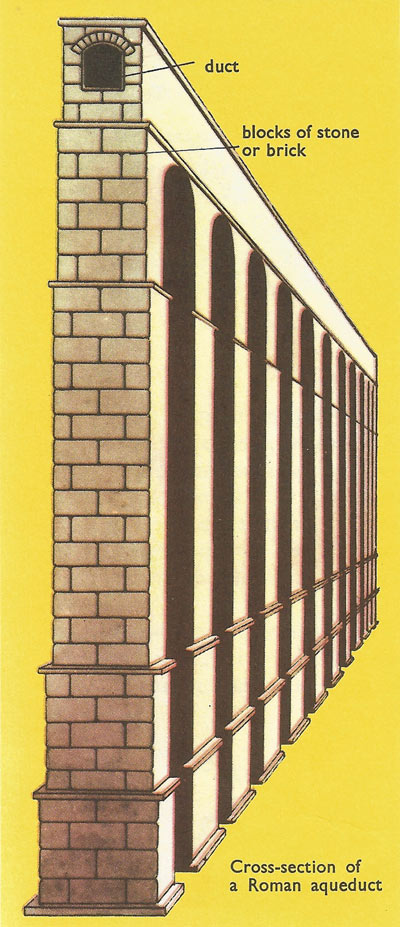
Cross-section of a Roman aqueduct.
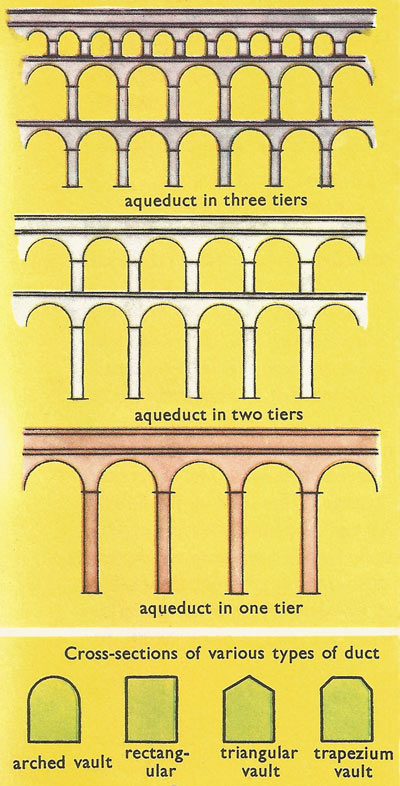
Types of aqueduct.
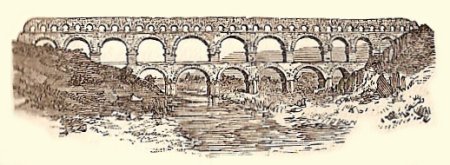
Pont du Gard, Nîmes.
An aqueduct is an artificial channel for conveying water, usually by gravitation. The term (from the Latin aqua, water; and ducere, to lead) is most commonly understood to mean a bridge of stone, iron, or wood, for allowing the passage of water across a valley. But a pipe, open channel, or a tunnel through a mountain is equally an aqueduct, if its purpose is to convey water from one place to another. All great aqueducts have been constructed for the purpose of conducting water from some more or less distant source to large towns or cities. The term is also applied to a bridge carrying a canal for the purposes of navigation.
Roman aqueducts
The aqueducts of the Romans were among the most magnificent of their works. In fact, three of the eleven ancient aqueducts built to supply Rome itself are still vital to the delivery of water into the present-day Italian capital. Moreover, scattered throughout the countries that once formed part of the Roman Empire, the massive ruins of more than 200 aqueducts can still be seen.
The source of a water supply, a spring or a river, was always higher than the town to which it was taken; so the water, following the law of gravity, was led gradually down in the aqueduct. As it was important that the fall in height should not should not be too rapid, the water was taken across valleys on tiers of stone or concrete arches. Even on plains it was necessary to keep the water high up, and the use of arches meant that the traffic was not inconvenienced. Sometimes it was possible to run the water through tunnels, but as labor and material were both cheap it was often easier to build aqueducts.
The water ran along ducts, or channels, which varied in width from 1 to 4 feet according to need, and were lined with a very hard waterproof cement. The section of the duct might be triangular, square, or many-sided.
Once it had reached the outskirts of the city, the water was stored in reservoirs (castelli) from which it was distributed throughout the city, by lead pipes, to public fountains, baths, and the private houses of the rich. As these pipes were easily tapped, it was quite common for citizens to draw off their own water supply without having to pay for it. Although severe laws were introduced to punish those who abused the public services in this way, the practice continued to flourish.
Sometimes the pipes were made of terra-cotta or wood, but this did not prevent people from drawing off water for their own use. On the Janiculum, one of the seven hills of Rome, water power was used to drive mills, but this was unusual.
The bridge portions of an ancient Roman aqueduct consist most frequently of one row of arches, but sometimes, as shown in the illustrations, of two, and occasionally, when the height is great, even of three tiers. Some of these were built of hewn stone and others of brick, but in nearly every case they were very substantially constructed. The water channel in one or two of the larger ones is about 5½ feet high and 4 feet wide. This was, of course, formed in the upper part of the structure, above the arches, and was covered on top, bottom, and sides with a lining composed of lime, sand, and pulverized brick, which in time became as hard as stone. The gradient of these ancient aqueducts was generally about 1 in 200, a much greater slope than is given to modern works of a similar kind. Reservoirs (castelli) were built at regular intervals along the aqueducts to enable repairs to be made, and to supply water, where necessary, to the inhabitants of the outlying districts.
At first sight it may seem surprising that the Romans built expensive aqueducts, but they were unable to make cast-iron pipes, or to devise other means, for carrying water underground for great distances. The aqueducts supplying Rome in Imperial times brought more than 200 million gallons of water a day into the city.
The aqueducts of Rome itself
The first Roman aqueduct was built into 312 BC by the Censor Appius Claudius and was called the Aqua Appia after him. This ran through tunnels because the Romans had not yet discovered the use of the arch; also, Rome still had powerful enemies in Italy, and an aqueduct above ground was more liable to be attacked and destroyed.
Later, however, the Romans learned the use of the arch from the Etruscans and they also removed the danger of attack by subduing all their enemies. So in 144 BC the Aqua Marcia was built, carrying the water to Rome across ravines and rivers on arches.
The finest of the Roman aqueducts is the Aqua Claudia, built in AD 38 by the Emperors Caligula and Claudius; it brought water to Rome from a place 45 miles away. Large portions of it are still standing in the countryside around Rome, and some of the arches are over 100 feet high. The three ancient aqueducts which still bring water to modern-day Rome are the Aqua Virgo, Aqua Trajana, and the Aqua Marcia. The Aqua Virgo, now called Acqua Vergine, was restored by Pope Nicholas V in 1453. Its name is said to have originated from a young girl having pointed out the spring at its source to some soldiers. The aqueduct was made by Agrippa, and finished about the year 27 BC. It mainly consists of a subterranean channel 14 miles long, and supplies daily about 13 million cubic feet of water. The Aqua Trajana was restored, in 1611, by order of Paul V, hence its modern name Acquala Paola. It stretches from Rome to the lake of Bracciano, a distance of 31 miles. The Aqua Marcia was constructed by the praetor Q. Marcius Rex in 146 BC and is 56 miles long. It was restored in 1869 and brings water from the Sabine Mountains. The impressive arches that stretch across the Campagna for some 6 miles on the road to Frascati are part of this aqueduct. Besides these three repaired ancient aqueducts, a fourth of comparatively recent date supplies modern Rome. This is the Acqua Felice, completed by Sixtus V in 1585, and largely built of material taken from the arches – about 10 miles in length – of the ancient Aqua Claudia. The length of the Acqua Felice is some 13 miles, and two-thirds of it is subterranean.
Provincial Roman aqueducts
Away from the capital there are a number of ancient Roman aqueducts in Italy itself. The ruins of one exist at Mayence, and of another near Metz, in Germany. France has, in the Pont du Gard at Nîmes, erected in the time of Augustus, one of the finest aqueduct bridges built by the Romans. It is higher than any about Rome itself, being 180 feet in height, and the length of the highest arcade is 873 feet. The Pont du Gard is part of a magnificent aqueduct over 25 miles long.
Spain also has interesting Roman works of this kind at Segovia, Tarragona, and Meridia. The one at Evora, in Portugal, is still well preserved, and the one at Segovia continues to bring the water supply to the city from a source 10 miles away.