
The Colosseum
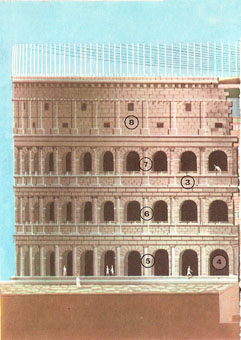
Exterior view of part of the Colosseum. 4. Numbered entrance doors (80 in all). 5. Ground floor of arches and Doric columns. 6. First story with Ionian half columns. 7. Second story Corinthian half columns. 8. Third story of brick (the last stories were added later).
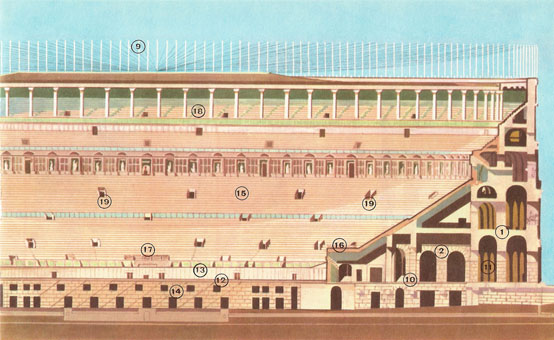
Section of part of the Colosseum. 9. Masts for awnings which protected the audience from the Sun. 10. Stairs leading to upper stories. 11. Covered galleries, where the public went during intervals of it rained. 12. Arena, covered with a movable wooden floor. 13. High parapets and metal nets to protect the audience from the animals. Even so, infuriated animals sometimes killed members of the audience. 14. Underground passages where the animals were kept in cages. 15. The seats. The rows were made of marble, each each seat was marked by two ridges. It is still possible to read names cut on the seats. They are presumably the names of regular spectators or of people who hired the seat permanently. 16. The podium where the first row of seats were reserved for officials. 17. Box for the emperor and his family. 18. The highest row of seats, like our theatre galleries. 19. Vomitoria, corridors through which the audience came to their seats
The Colosseum was the greatest of Roman amphitheaters. Oval in shape it measured 610 feet by 509 feet; the outside walls were 163 feet high and there were four stories. The building of it was begun in AD 74 by the Emperor Vespasian; it was finished in about AD 80 by the Emperor Titus. Both these members were members of the Flavian family, which is why it was called the Flavian amphitheatre. It was not until the Middle Ages that it came to be known by its more familiar name of the Colosseum, not because of its great size but because on this site originally stood a colossal statue of the Emperor Nero. Although this was removed to make way for the amphitheatre, the name remained.
For more than two centuries the arena of the Colosseum was the scene of unbelievable cruelty; men and animals were slaughtered in their thousands to satisfy the Romans' thirst for excitement. It was also the scene of the martyrdom of many Christians. When Christianity became the official religion of the Roman Empire in AD 313, there were fewer gladiatorial fight, but it was not until AD 404 that the Emperor Honorius banned them altogether. Gradually, the Colosseum was abandoned, and in the Middle Ages it was used as a fortress. Although lightning, fires, and earthquakes damaged the vast building, humans were chiefly responsible for its destruction. For centuries it was the marble quarry of Rome, and many buildings, including St. Peter's, were built from materials pillaged from it. Yet even today enough still stands to give us an idea what it must have been like 2,000 years ago.
Materials used in construction
1. Tufa (a kind of porous stone) and brick for the inner walls.
2. Pumice stone for the vaults to reduce their weight.
3. Travertine (light-colored limestone) blocks for the walls.
Scenes from the Colosseum
The poet Martial has left us a description of some of the shows that were organized during the first 100 days after the Colosseum opened on 1 May AD 80. On the first day more than 100 pairs of gladiators fought in the arena from morning to evening. The gladiator who lost his fight was usually killed by the victor, unless the crowd thought that he had fought particularly bravely.
On the following days the shows included venationes. These were wild-beast hunts, which took place in the area amid forest scenery. The more unusual the animals, the better the crowd were pleased; and tigers, ostriches, and even rhinoceroses were imported at vast cost just to be slaughtered. On one day over 5,000 beasts were killed. The naumachiae were also very popular. These were mock naval battles fought in small boats. For these shows the arena was filled with water.