
Colossus of Rhodes
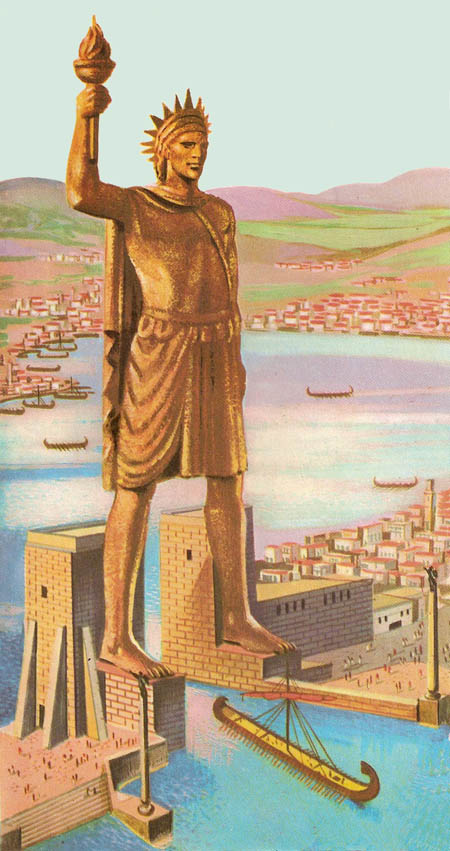
A reconstruction of the Colossus of Rhodes based on a Medieval concept.
The Colossus of Rhodes was one of the seven ancient wonders of the world. A colossus is a statue larger than life. The most famous colossus of antiquity was the Colossus of Rhodes, erected between 292 and 280 BC. It was a bronze statue of the sun god Apollo, cast by Chares of Lindos. No one knows exactly what it looked like; but the common view – that its legs straddled the entrance to the harbor, so that ships passed beneath it – is an invention of the Middle Ages. About 56 years after it was put up the Colossus was overthrown by an earthquake. Pliny, more than 300 years later, described its finger as larger than a statue of ordinary size; but this is an exaggeration, for the statue was, in fact, about 105 feet high. It disappeared in AD 672 when a Jewish traveler from Emesa bought the fragments, loaded them on to 900 camels, and carted them away.