
Mausoleum
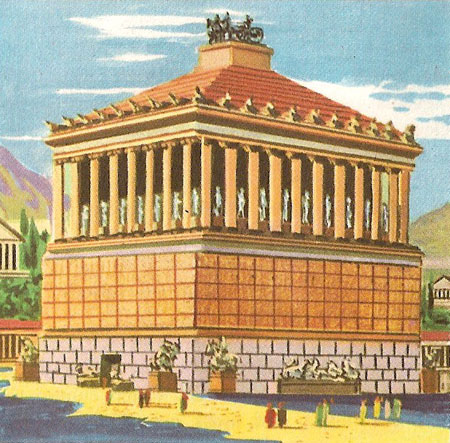
An artist's reconstruction of the Mausoleum.
The Mausoleum was the tomb of Mausolus, king of Caria in Asia Minor, who, by his lavish program for beautifying his capital at Halicarnassus and his patronage of the arts, foreshadowed the Hellenistic kings of the next century. It was one of the Seven Wonders of the World. Mausolus died in 350 BC. His sister, who was also his wife, supervised the building of the tomb. The Mausoleum, designed by Pythius, was a rectangular building of the Ionic order some 40 meters (130 feet) high; above the colonnade rose a pyramidal roof topped by a four-horse chariot. An earthquake destroyed the Mausoleum before the fifteenth century; but excavations have revealed fragments, including a statue of Mausolus himself which is almost intact.
The term "mausoleum" has come to be applied to any structure specifically designed to house bodies above ground, as distinct from structures designed for underground burial or receptacles for holding ashes.
In Italy the Roman emperors preserved the Etruscan tradition of tomb chambers covered by tumuli, the mound being given massive architectural form and faced with marble, e.g., that of Augustus, begun 28 BC of which only parts survive, and that of Hadrian, begun c. AD 125–30, now incorporated into Castel S. Angelo, both in Rome. From the fourth century mausolea were built for Christians, e.g., that of Theodoric, Ravenna, (c. AD 526). Classical style mausolea were revved by Protestants in eighteenth-century England, sometimes set in landscape gardens.
Mausolea of great architectural distinction were built for Muslims despite Muhammad's reported injunction against them. None is earlier than the late ninth century (the octagonal Qubba-al-Subabiya, 862) but from the tenth century they increased: the Tomb of the Samanids, Bukhara, Uzbekistan (c.914–43); the tomb towers of Iran, notably Gunbad-i Gabus, near Gurgan (1006–1007); the vast Uljaytu at Sultanita, Iran (1313); and, in India, those of the Mughal emperors, notably the Taj Mahal, Agra (1613–1647).
The most prominent twentieth-century mausolea are secular, notably those of Lenin, Moscow (1924–3), of Ataturk, Ankara (1944–1953), and of Mao Ze Dong in Tiananmen Square, Beijing (1958).