THE MOON: A Spaceflight Away - 3. Exploring the Moon

The side of the Moon that faces Earth.
In September 1959, the Soviet Union's Luna 2 crashed into the Moon near a big crater called Archimedes. It was the first spacecraft to reach another world. Just a few weeks later, Luna 3 sped around the Moon and sent back pictures of the lunar far side. The exploration of the Moon had begun.
Robot Explorers
Luna 3's pictures surprised everyone. They showed that the Moon's far side is quite different from the side we can see from Earth. The far side has hardly any low-lying plains. Instead, it's almost totally covered by craters and mountains. Scientists still aren't sure why there should be such a big difference between the Moon's two halves.
In April 1962, the United States joined the Soviet Union in exploring the Moon. Ranger 4 became the first American spacecraft to reach the lunar surface. Then, between 1964 and 1965, other Rangers crashed into the Moon. As they zoomed in at high speed, they sent back thousands of close-up photographs. These missions were a part of America's plan to land astronauts on the Moon.
The Soviet Union's Luna 9 followed with a lunar soft landing in 1966. Some scientists had thought that the Moon might be covered with a thick layer of dust. Such a soft surface would have made it dangerous for astronauts to try to land there. But Luna 9 didn't sink down. Instead, it sent back the first pictures from the Moon's surface.
America's Surveyor spacecraft also made several soft landings on the Moon. They sent back pictures of cratered, rocky deserts and showed, by testing the soil and rocks, that the Moon was a safe place for people to visit.
High above the Moon, other spacecraft were carrying out the final plans for America's astronauts to land. These were the Lunar Orbiters. By taking close-up pictures of every part of the Moon, they let scientists make the most detailed maps ever of the lunar surface. From these maps, the best places for the Apollo landings could be chosen.
Humans Explorers
On December 21, 1968, many millions of people around the world watched TV pictures of three American astronauts as they orbited the Moon in Apollo 8. Five months later, the crew of Apollo 10 took their "lunar module" to within 9 miles (about 14 kilometers) of the Moon's surface. Then, came the great event itself.
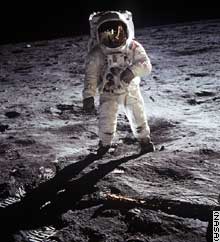 |
| Buzz Aldrin on the Moon
|
On July 20, 1969, Apollo 11's Neil Armstrong and Edwin ("Buzz") Aldrin made the first human landing on another world. As the two astronauts carefully controlled the flight of their spacecraft, the Eagle touched down in the Sea of Tranquility. Later, the astronauts went on a moon walk lasting a little more than two hours. They gathered rock and soil samples, and took hundreds of photographs. Before they left, they set up a number of experiments on the lunar surface.
Armstrong and Aldrin were followed, during the next few years, by ten other Moon explorers – the astronauts of Apollo 12, 13, 14, 15, 16, and 17. Each Moon mission was more difficult and more exciting than the one before. The people of Earth saw astronauts standing by giant lunar boulders and rolling stones down the side of a crater. We even saw them driving a special "lunar rover" across the Moon's bumpy, dusty surface. But more importantly, because of the Apollo flights, we learned a great deal about what the Moon is made of and what may have happened to it in the distant past.
The Unchanging Moon
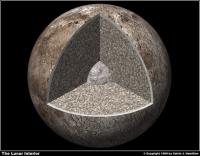 |
| A view inside the Moon
|
If we could cut the Moon in half, we would find that it's made of three different parts. In the middle is a small ball of hot, heavy, partly melted rocks called the core. Around this core is a deep layer of lighter, but still partly melted, rocks called the mantle. Finally, on top of the mantle is the Moon's rocky outer skin, or crust.
The Earth also has a core, a mantle, and a crust. In the case of the Earth, the crust is so thin that it's able to move around on top of the warmer, partly melted mantle. This movement makes the Earth's land and oceans change shape over long periods of time. Sometimes gaps open up between different parts of Earth's crust. Then hot lava gushes up from the mantle and escapes through volcanoes, or through great cracks, at the surface.
Unlike the Earth, the Moon's crust today is quite thick and stiff. It doesn't change the Moon's appearance by moving around. And it doesn't allow the softer mantle rocks to break through to the surface.
The Moon is different from the Earth in other ways, too. Since it has no atmosphere, it has no weather, no water, and no rivers or oceans. Without a moving crust, and without wind, rain, and moving water, not much is left that can change the lunar landscape. Only the heat of the day, the chill of the night, and space rocks such as meteorites that bump into the surface, can change the way the Moon looks.
To scientists, the Moon is like a world frozen in time. It is almost the same today as it was billions of years ago. That means many of the rocks brought back by the Apollo astronauts are unchanged from when the Moon was quite new. By studying the Moon and its rocks today, then, scientists can get a good idea of what has happened to the Moon in the distant past.
How the Moon was made
The Moon seems to have formed, like the Earth, about 4½ billion years ago. To begin with, it was a very hot ball of liquid rock. Later, its surface cooled and hardened. But exactly how the Moon came to be a satellite of the Earth isn't known for sure.
 |
| A huge collision probably formed
the Moon
|
The Moon may always have gone around the Earth. According to this idea, the two objects were formed as close neighbors in space. On the other hand, the Moon may once have been a separate planet that was later "captured" as it strayed too near the Earth. But scientists now think that a third explanation is most likely correct. According to this idea, the Moon was formed from material splashed out of the Earth when another object, about as big as the planet Mars, slammed into our world.
However it was formed, afterward the Moon began to cool. Its surface hardened into a crust of solid rock. Then a very interesting thing happened. Rocks of every size, from mountains to pebbles, came raining down on the Moon's newly-made surface. These were asteroids and meteorites left over from the time when the Sun and planets were formed.
Crashing meteorites made many of the moon's craters – large and small – that we see today. Giant asteroids dug out the much bigger holes, or basins, of the maria.
At the same time, the Moon's crust – weakened and softened by the falling meteorites and asteroids - allowed hot rocks from the mantle to reach the surface. Volcanoes erupted, adding more craters to those made by the meteorites.
About 3½ billion years ago, great streams of lava poured through the crust into the maria basins. After a while the maria became filled with hardened lava that's darker in color than the older, crust rocks of the highlands. Smaller lava flows resulted in such maria features as the strange rilles, ridges, and domes.
About 3 billion years ago, the Moon reached the end of its action-packed youth. It looked then very much as it does today. The maria and highlands were formed, the rain of space rocks had stopped, and the crust had once again hardened to prevent the escape of the mantle rocks.
For the last 2 or 3 billion years, very little has happened on the Moon. From time to time there's been a "moonquake." These quakes are far less powerful than even a mild earthquake. Scientists have spotted color changes in some craters that may be due to small volcanic eruptions, though no one knows for sure.
At least two large meteorites have hit the Moon, too. The first, about 1 billion years ago, made the crater Copernicus. The second, perhaps as recently as 100 million years ago, resulted in the crater Tycho. Both Copernicus and Tycho are surrounded by beautiful rays, hundreds of miles long, made of light-colored crust material thrown out by the force of the meteorite impacts.
From careful studies of the Moon rocks brought back by the Apollo astronauts, scientists have learned a great deal about the Moon's history. But what have they found out about the rocks themselves?
Pieces of Another World
Most Moon rocks are quite like rocks from around volcanoes on Earth. They are made of basalts – different kinds of crystals that have formed from pools of cooling lava.
Some rocks, taken from the highland parts of the Moon, are from 4 to 4½ billion years old. Others, made of so-called KREEP basalts, are slightly less than 4 billion years old. And still others, formed when the great lava flows filled the maria, are about 3½ billion years old.
This last group is made of basalts that have a lot of the metals iron and titanium in them. Some people have said that we should try to mine the moon's titanium. In the future, they say we could use it for building spaceships and structures on the Moon.
One of the big surprises of the Moon rocks is that they contain tiny glass beads. These little balls of glass must have been made from Moon dust heated to a very high temperature by meteorites that fell a long time ago.
At first, scientists handled the Moon rocks very carefully in case they had any form of life in them. A special place was built in which to study the rocks. That way, if there were strange lunar bugs, they couldn't escape to harm anyone. But no signs of life were found. The Moon, it seems, is a world that has always been completely dead.