
downwind wind turbine
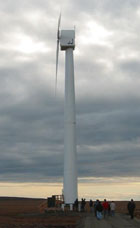
A downwind wind turbine is a horizontal-axis wind turbine in which the rotor is downwind (i.e. on the lee side) of the tower. Downwind machines have the theoretical advantage that they may be built without a yaw mechanism, if the rotor and nacelle have a suitable design that makes the nacelle follow the wind passively. For large wind turbines this is a somewhat doubtful advantage, however, since cables are needed to lead the current away from the generator. How do you untwist the cables, when the machine has been yawing passively in the same direction for a long period of time, if you don't have a yaw mechanism? (Slip rings or mechanical collectors are not a very good idea if you are working with 1000 ampere currents). A more important advantage is that the rotor may be made more flexible. This is an advantage both in regard to weight, and the structural dynamics of the machine, i.e., the blades will bend at high wind speeds, thus taking part of the load off the tower. The basic advantage of the downwind machine is thus, that it may be built somewhat lighter than an upwind machine. The basic drawback is the fluctuation in the wind power due to the rotor passing through the wind shade of the tower. This may give more fatigue loads on the turbine than with an upwind design.
 |