
horizontal-axis wind turbine
A horizontal-axis wind turbine (HAWT) is a wind turbine in which the axis of the rotor's rotation is parallel to the wind stream and the ground. All grid-connected commercial wind turbines today are built with a propeller-type rotor on a horizontal axis (i.e. a horizontal main shaft). Most horizontal axis turbines built today are two- or three-bladed, although some have fewer or more blades. The purpose of the rotor is to convert the linear motion of the wind into rotational energy that can be used to drive a generator. The same basic principle is used in a modern water turbine, where the flow of water is parallel to the rotational axis of the turbine blades.
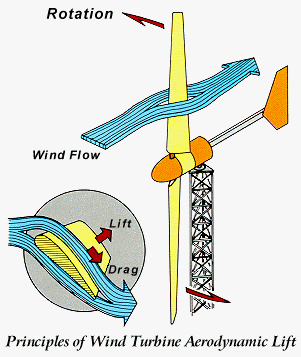
The wind passes over both surfaces of the airfoil shaped blade but passes more rapidly over the longer (upper) side of the airfoil, thus creating a lower-pressure area above the airfoil. The pressure differential between top and bottom surfaces results in aerodynamic lift. In an aircraft wing, this force causes the airfoil to rise, lifting the aircraft off the ground. Since the blades of a wind turbine are constrained to move in a plane with the hub as its center, the lift force causes rotation about the hub. In addition to the lift force, a drag force perpendicular to the lift force impedes rotor rotation. A prime objective in wind turbine design is for the blade to have a relatively high lift-to-drag ratio. This ratio can be varied along the length of the blade to optimize the turbine's energy output at various wind speeds.
HAWTs can be subdivided into upwind wind turbines and downwind wind turbines. Compare with vertical-axis wind turbine.