
log home air leakage and thermal imaging
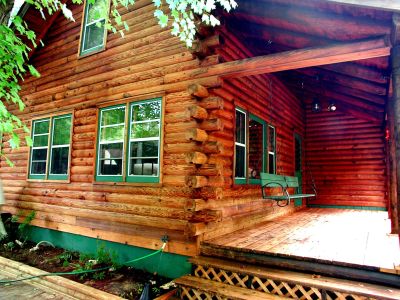
Log homes may appear idyllic but they need extensive, on-going maintenance. Perennial issues that have to be dealt with in every log home are air leakage and bug intrusion – problems which often go hand in hand.
A valuable technique for identifying gaps through which air and bugs can pass is infrared thermal imaging or thermography. To work properly this needs an 18° to 20°F differential between the inside and outside temperatures. Using a blower door test, a negative pressure is created that causes outside air to be forced in through any areas of the home that have been compromised. The imager can then detect these areas of leakage with an infrared camera and produce reports that precisely pinpoint where the air is coming into the home. This could be from checks (cracks) in the logs or even cracks or holes in the chinking.
Logs tend to "breathe" (i.e., expand and contract) with the changing seasons. Although the process is normally invisible, it can lead, over time, to heat loss and intrusion by water and insects, such as black flies and stick bugs. Checks in logs are created by moisture evaporating out of the logs. These checks widen more and more, with repeated warming and cooling of the outside air. Without infrared thermal imaging of a log home, there is no way to know if a check goes all the way through a log or not, and therefore it is hard to know when and where to apply appropriate treatment.
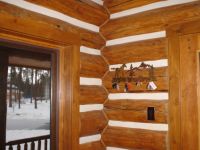 |
| Interior walls of a log home
|
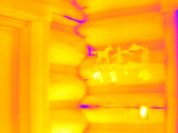 |
| Thermal image of log home interior
|
The dark blue areas in the far picture to the right show the checks in logs that leak all the way to the outside. These checks may be only one eighth of an inch wide and normally unnoticeable, yet big enough to allow the escape of heat and the intrusion of black flies. After a typical thermal imaging survey, the home owner receives a report, which may include details of how much energy (and money) is being lost because of cracks.
Knowing the location of problem areas, the job of sealing a log home is greatly simplified. Wherever a check or crack is found in a log, a piece of backer rod (a pliable triangular star foam rod) is inserted into the crack, leaving a quarter-inch depth from the top. Caulking, such as Sascho or Weatherall, is then placed over the backer rod to provide a good seal. The passage of heat, water, and insects and is blocked in this way.
Typically, using thermal imaging, a home owner will recoup the cost of the survey within six months. However, the process may need to be repeated every year to prevent the same problems from recurring.
For further information on thermal imaging, visit the website of Thermal Imaging and Log Technologies.