
Buildings of Imperial Rome
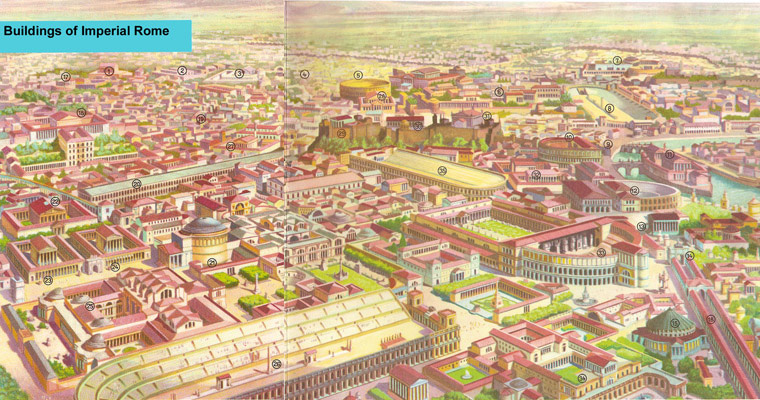
Reconstruction of the city of Rome at the time of the Emperor Aurelian (AD 270-275). 1. Temple of Minerva; 2. Baths of Trajan; 3. Baths of Titus; 4. Colonnade of Livia; 5. Colosseum; 6. Imperial Palace on the Palatine; 7. Baths of Caracalia; 8. Circus Maximus; 9. Forum Boarium; 10. Theater of Marcellus; 11. Insula Tiberina; 12. Theater of Balbus; 13. Temple of Mars; 14. Arch of Tiberius; 15. Odeon; 16. Porticus Maximae; 17. Baths of Olympias; 18. Temple of the Sun; 19. Suburra; 20. Saepta Julia; 21. Pantheon; 22. Temple of Hadrian; 23. Temple of Neptune; 24. Temple of Juturna; 25. Baths of Nero; 26. Circus of Alexander Severus; 27. Trajan's Forum; 28. Temple of Venus; 29. The Capitol; 30. Tabularium (Records Office); 31. Temple of Jupiter; 32. Temple of Hercules; 33. Pompey's Curia (Senate House); 34. Palace of Alexander Severus; 35. Circus Flaminius.

A street in ancient Rome. An aristocrat's house (right) and an insula (left).
It was the boast of Augustus, the first Roman emperor, that he had found Rome made of brick and left it made of marble. What he meant was that he had changed the whole face of the city by his extensive building program. In what follows we shall be concerned only with the buildings in Rome of the Imperial period – in other words, those erected after 27 BC.
In the inscription which Augustus wrote to be placed on his tomb he gave a list of all the buildings which he had had erected or restored. His example was followed by all his successors until the growth of Rome came to an end when the capital of the Empire was transferred to Constantinople in AD 324. Every emperor was anxious to ensure that his memory survived in one or more remarkable buildings.
It would be impossible to give a complete list of all the triumphal arches, baths, temples, and other monuments erected by each emperor, but some of the better-known ones can be mentioned.
The forums
Augustus realized that the original Forum was not large enough for the needs of the growing city, and so he built a new one: later emperors did the same until there were no less than eleven forums in the city of Rome! After the great fire in Rome in AD, Nero began to build himself a great palace, the Domus Aurea, or Golden House. This building occupied so much space that it was said that all other Romans would have to leave Rome.
After Nero's death, Vespasian built the Colosseum on the site of the Domus Aurea. One of the most splendid temples in the world was the Temple of Venus and Roma. The Emperor Hadrian designed and built it himself, and one of the leading architects of the day was said to have been put to death for saying that the statues of the gods inside the temple would hit their heads if they stood up.
At first, building was concentrated round the Forum, but as this area became more congested, the buildings moved further away. Eventually the whole of Rome was a mass of monuments. The last monument to be erected in the Forum was the column erected by the Byzantine Emperor Phocas in AD 610.
Houses and addresses in Rome
It is often thought that Roman houses were spacious villas, only one story high, with large sunny gardens. However, ancient Rome, at the height of its power, had a population of well over one million inhabitants; it is not, therefore, very surprising that most Romans actually lived in insulae, which were tall buildings, often of six or seven stories, the equivalent of our modern apartments. It has been calculated that there were about 46,000 of such insulae. We know from the poets Martial and Juvenal that conditions in these buildings were very primitive: there was often no water supply, and several families would occupy one room. These buildings were often in danger of collapsing and laws were passed limiting their height. The houses of wealthy aristocrats and merchants were not so cramped, but even these often rose to three stories.
In spite of the size of the city very few of the streets were named, and none of the houses were numbered. It must have been very difficult for a Roman of those days to give a friend his address if he had invited him to his house. Martial tells us that his own address was "the street of the pear tree on the Quirinal." This, though not precise, was simple compared with another address Martial mentions: "On the slopes of the Palatine near the temple of Bacchus and the dome of Cybele, immediately to the right as you reach the temple of Venus."
The chief public buildings of Rome were located round the Forum.