COULD YOU EVER DIG A HOLE TO CHINA?: 4. The Deepest Holes in the World
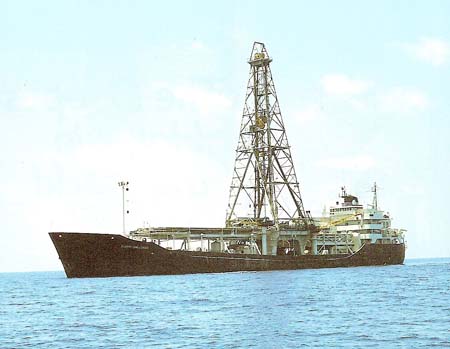
Figure 1. The Glomar Challenger helped scientists learn more about the makeup of the Earth's crust beneath the oceans.

Figure 2. Some of the deepest holes, natural and manmade, in the world.
Oil, like coal, is a fossil fuel. In other words, it formed from the squashed remains of animals and plants that died hundreds of millions of years ago. But instead of being mined, oil is brought to the surface through wells that are drilled through the rock that lies above it. Today, scientists employ the methods used to recover oil to drill deep holes. In this way, they hope to learn more about the makeup of the Earth's crust.
A specially equipped American research ship, the Glomar Challenger, carried out a worldwide survey of the rocks beneath the sea. In 1976, as part of the United States Deep Sea Drilling Project, Glomar Challenger drilled to a record depth of 5,709 feet below the ocean floor off the northwest coast of Spain.
On land, where most permanent drilling rigs can be set up, much deeper bore-holes have been sunk into the Earth. In Russia's Kola Peninsula, 155 miles north of the Arctic Circle, scientists have been drilling what is now the world's deepest well.
Hitting a New Low
The bottom of the Russian hole is now more than 7.6 miles beneath the Earth's surface. Further progress, though, will only come very slowly. Every time the drill bit that cuts into the rock wears out, the entire 39,000-foot-long drill assembly has to be lifted out so that a new bit can be fitted.
In an ordinary well, the whole drill stem is rotated in order to turn the drill bit at the end. But as the drill gets deeper, more and more energy is lost by the stem rubbing against the side of the hole. To solve this problem, new drilling methods have been developed. In the Kola well, the drill bit is mounted on a turbine, a device like a propeller. The turbine is spun around by pressurized mud pumped down the hole. Since the only moving part is the bit itself, friction is greatly reduced.
The mud that drives the turbo-powered drill also picks up fragments of rock and brings them back to the surface where they can be examined. In this way, Russian scientists have been able to learn a great deal abut the structure of the crust below the Kola site. For the first half of the drilling, the rocks were found to be about 1.1 billion years old. But in the lower half of the well, the rocks have been dated at more than 2.7 billion years old. Below a depth of 5.5 miles, nearly half the rock consists of ores rich in metals such as iron and titanium. Most surprising of all, the Russian team discovered large amounts of hot water deep within the hole that had cracked the surrounding rock.
As the Kola well deepens, drilling becomes more and more difficult. Already, the temperature of the rock at the bottom of the shaft is nearly 400°F, and the pressure is hundreds of times that at the surface. Even so, Russian scientists hope to extend the Kola well down to a depth of between 9 and 10½ miles.
Sampling the Crust
The success of the new drilling techniques pioneered by the Russian scientists has encouraged other groups to make plans for super-deep wells. In Russia, a number of these will be drilled for studying oil- and gas-bearing rocks. Others will be used to search for ores and for basic research. Improved equipment such as high-strength alloy drilling pipes could lead to holes being drilled even deeper than that on the Kola Peninsula.
Germany, too, has begun a huge drilling program close to the Czech border. If all goes well, this project will sample the Earth's crust down to a depth of 8½ miles. Similar projects are bring considered in France, Britain, and the United States.
However great these accomplishments may be, they are like tiny pinpricks compared with the size of our whole planet. The Kola hole, after more than 20 years of drilling, reached only a five-hundredth of the way to the center of the Earth. What hope is there that people or machines might penetrate much more deeply underground in the future? Could we eventually break through the crust and travel down into the mantle or even to the Earth's core?