MAKING LIGHT WORK: The Science of Optics - 4. When Light Bends
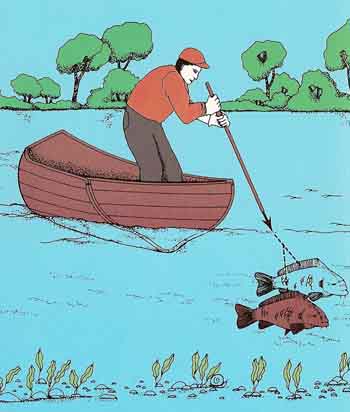
Figure 1. The effect of refraction when spear fishing.
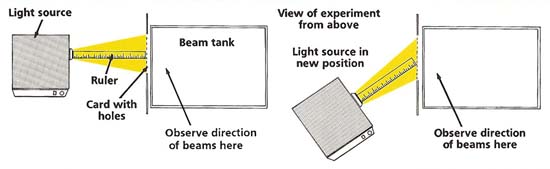
Figure 2. Refraction experiment.
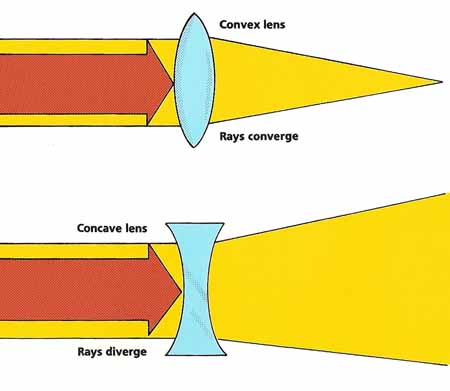
Figure 3. How convex and concave lenses bend light as it passes through them.
Spear fishermen use a strange trick to catch their prey. They aim at a point slightly below where the fish seems to be (see Figure 1).
The reason is that light changes direction when it moves from one transparent substance, such as water, to another of different density, such as air. This change of direction is called REFRACTION.
You can find many examples of refraction in everyday life. A bar of soap at the bottom of a bath appears to be higher than it really is. A pencil seen through the side of a water-filled jar seems to be broken. And a riverbed, seen from the bank, looks shallower than its true depth.

Refraction in ActionYou will need:
What to do:
Lay down the ruler so that it extends from the light source to the base of the holed card. Line up the ruler with the center of the incoming light beam (see Figure 2).
First, arrange for the light to come in at right angles to the card. Look down on the beam tank. Has anything happened to the direction of the light as the beam goes from air to water?
Now move the light source around to one side slightly so that the incoming beam is still pointing at the holes in the card but is no longer square on the card. Again, place the ruler so that it lies exactly along the center of the incoming beam. Look closely at the direction of the light after it has entered the water. What do you notice? |
A Change of Course
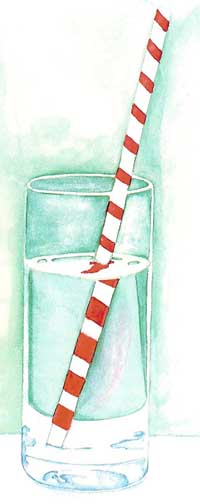 |
| A straw in water appears bent because of
refraction
|
Light travels faster through air than it does through a denser substance, such as water or glass. So, when light rays travel through air and meet the surface of the denser substance, they are suddenly slowed down. When this happens, the light rays bend.
You can see a similar effect if you throw a stone at a slant into water. As it leaves the thinner air and enters the thicker water, it slows and is dragged on a more downward path. The only exception to this is when the incoming rays (or stone) meet the surface at right angles. In this case, there is no change of direction.
Mirages
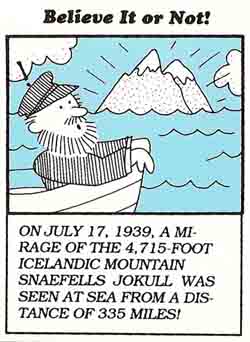
On a hot day, you can sometimes see what looks like a pool of water on the ground – even though the ground is completely dry. In fact, the "pool" is caused by refracted light from the sky. The air close to the ground becomes hotter and, therefore, less dense than the air higher up. This change in density causes light from the sky to be bent upward so that it reaches your eyes from the direction of the ground. The effect is called a MIRAGE and is common on hot roads and in deserts. As well as the sky, mirages of distant objects on the horizon such as mountains may be seen.
 |
Lenses
Refraction can be put to good use by shaping pieces of glass so that one or both sides are smoothly curved. These curved pieces of glass are called LENSES. As light passes through them it is bent in a special way, following a certain order.
Just as there are convex and concave mirrors, so there are convex and concave lenses (see Figure 3). In a convex lens, the glass bulges out from the edge to the center, while in a concave lens it curves the other way.
|
Lens PowerYou will need:
What to do:
Hold the convex lens a few inches above the words on this page. Do the words look bigger, smaller, or the same size? Are they upright or not? Measure how far the lens can be placed from the page before the letters start to become blurred. Call this measurement A.
Now put the convex lens upright about six feet away from a source of light such as an electric light bulb. Let the light that passes through the lens fall onto the white card. Move the card (or the lens) until you obtain a small, sharp image of the light source on the card. Measure the distance from the lens to the card. This distance is known as the focal length of the lens. Call it measurement B. Compare measurements A and B. Which is greater?
Hold the convex lens at arm's length and look at a distant object. What do you observe? Does the object look large, smaller, or the same size? Which way up is it?
Now take the concave lens. Hold it a few inches from this page. What effect does it have on the words? What happens as you move it farther and farther from the page? Do the words eventually become blurred as they did with the convex lens? Hold the concave lens at arm's length and look at a distant object. What do you observe?
Taking it further:
Hold the convex lens upright in the beam tank in the path of the light rays. Look down from above and from the side. What do you observe? Measure the distance from the lens to the point where the light rays cross. Does this agree with your earlier measurement of the focal length?
Replace the convex lens with the concave lens. What happens to the light rays? |
Larger and Smaller
Placed near an object, a convex lens acts as a magnifying glass. The amount by which it makes things seem bigger depends on the curvature of its sides.
A convex lens will also focus, or bring to a point, the light rays from an object that is far away. The distance from the lens to the point of focus is called the FOCAL LENGTH. An object will only be magnified by a convex lens if it lies within the focal length. Exactly the same is true of a concave mirror. Held at a distance from the eye that is greater than the focal length, a convex lens will show distant objects upside down and reduced in size.
A concave lens works in a similar way to a convex mirror. It spreads light rays apart rather than bringing them together, and it makes objects at any distance seem smaller than normal.