FROM GLASSES TO GASES: The Science of Matter - 2. Solids and Solutions
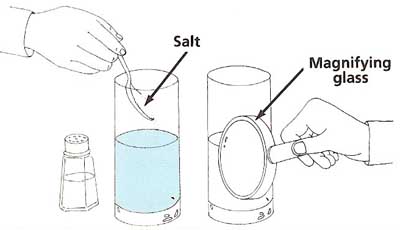
Figure 1. An experiment with solutions.
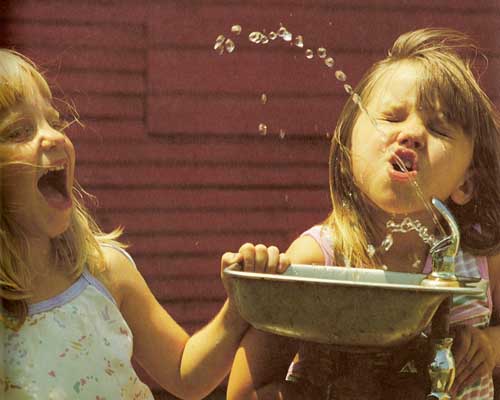
Figure 2. Water is a common solvent.
The next time you take a sip of cola, think about what you are drinking. It's mostly water, with some sugar, carbon dioxide gas (to make it fizz), and a few drops of flavorings and colorings. Cola is a solution – a mixture of several things that look and behave like a single thing.
A solution is made by dissolving one or more substances in a liquid such as water or alcohol. Ordinary table salt, or sodium chloride, dissolves well in water. It has a high solubility. Huge amounts of sodium chloride, together with other kinds of salts, are dissolved in the world's oceans and seas.
 |
| Seawater is a solution of different kinds
of salts in water
|
Solutions also contain a mixture of liquids and gases. The water in swimming pools, for example, contains a dissolved gas called chlorine. This kills germs so that the water is safe for swimming.
Solubility, like hardness and density, is an important property of matter.

Making SolutionsYou will need:
What to do: Look at a few crystals of table salt under the microscope. What shape are they? Sketch some of the crystals. Do the same with a few crystals of sugar. What do you think the shape of the crystals tells you about the arrangement of atoms in these substances? (see Figure 1)
Pour a cup of cold water into the glass. Add a teaspoonful of salt to the water and stir. Watch what happens through the magnifying glass. When all the salt has dissolved, add another teaspoonful and stir. Repeat this until no more salt will dissolve. How many teaspoonfuls did you use?
Empty the glass and rinse it out. Pour in another cup of cold water. Find out how many teaspoonfuls of sugar you can dissolve. Which has the higher solubility in cold water – salt or sugar? Repeat the experiment using hot water. Does the solubility remain the same, increase, or decrease? Invent a theory to explain your results.
Taking it further:
Test the solubility of other substances at home or in your school laboratory. Ask permission first and remember that many chemicals are poisonous if swallowed. What happens if you pour a solution into a shallow dish and allow it to stand for several days? Can you explain what happens? |
Dissolving and Melting
Sugar will dissolve and it will also melt, but the two are not the same. When sugar is dissolved in water, it makes a sweet-tasting solution. When sugar is melted in a heated pan, it turns into a brown, sticky liquid that is used in making caramel.
There are several important differences between dissolving and melting:
Dissolving
Melting
All substances will melt, but not all will dissolve. A substance that will not dissolve in a liquid is said to be INSOLUBLE in that liquid.
Most solids become more soluble as the temperature of the liquid increases. Gases, on the other hand, become less soluble as the temperature rises. Natural water in lakes and rivers contains dissolved gases from the air, such as oxygen and carbon dioxide. More gas dissolves if the water is colder or the water flows over waterfalls, where it mixes more freely with air. This explains why fish caught in rivers cannot usually survive in indoor fish tanks. The water in such tanks is warmer, so it cannot dissolve enough oxygen for the fish to breathe.
Molecules That Fit Together
Molecules come in all shapes and sizes, like the pieces of jigsaw puzzles. The shape of a molecule affects how well it can work with other molecules. Neither water nor alcohol molecules, for instance, fit together well with their own kind. But when the two liquids are combined, the alcohol molecules fit into the gaps between the water molecules. Because of this, the space the mixed molecules take up is less than the original spaces they occupied.
|
The Missing LiquidYou will need:
What to do:
Pour all the water and rubbing alcohol into the measuring cup. How much liquid is in the cup? You might expect that it would be two cups, but is it? Try to explain your results. |
In Search of Solutions
A liquid that dissolves something is called a SOLVENT. The most common, and one of the best solvents, is water (see Figure 2). But there are many substances that will not dissolve in water. Oils and greases are insoluble in water but very soluble in other liquids, such as trichloromethane, or cleaning fluid. This solvent is used by dry cleaners to remove grease stains from clothes. Nail polish is insoluble in water but dissolves easily in a liquid known as acetone. Nail-polish remover is made of acetone.
 |