SPIDERWEBS TO SKYSCRAPERS: The Science of Structures - 2. Shaped for Strength
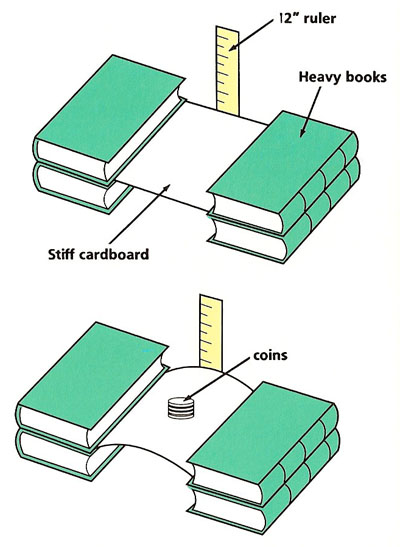
Figure 1. Experimenting with beams and arches.
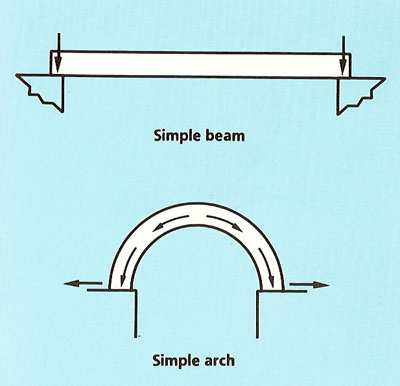
Figure 2. The forces acting on a beam and an arch.
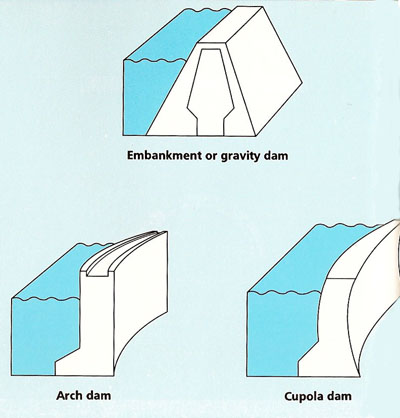
Figure 3. Types of dam.
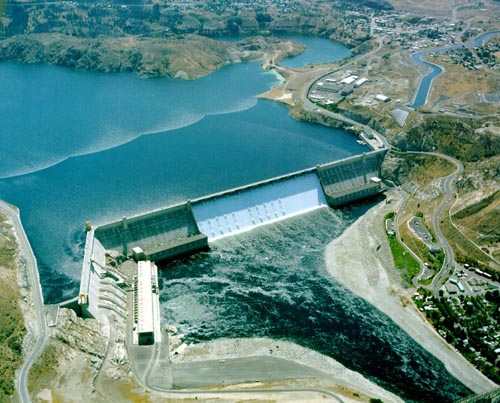
Figure 4. The Grand Coulee Dam in Washington is an embankment, or gravity, dam.
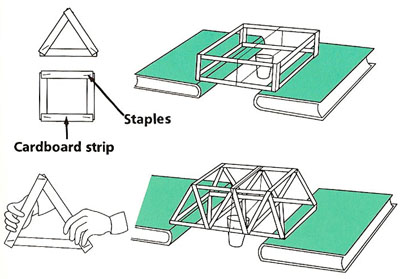
Figure 5. Experimenting with box-shaped and triangular frameworks.
It is much harder to break an egg squeezing it from end to end than by squeezing it across the sides. The reason is not that the eggshell is thicker at the ends, but that it is more highly curved – a fact that is important in the design of every structure, from a sports stadium to a subway.

Bridge that GapYou will need:
What to do:
Place two of the books on a table 5" apart. Mark the midpoint of the cardboard. Lay the cardboard across the gap so that the pencil mark is exactly at the middle of the gap. Put down two more books on top of the first pair (see Figure 1). Measure the height of the center of the cardboard above the table.
Place a coin on the midpoint of the cardboard. What happens? Measure the height of the midpoint above the table. Put another coin on top of the first and again measure the height of the center of the cardboard. Repeat this until the cardboard bridge collapses.
Draw lines on the cardboard 2" from either end, and make folds along these lines. Tuck the 2" flaps under the top pair of books so that the section in between makes a smoothly curving arch. Repeat the experiment above, measuring the height of the top of the arch as you add each coin. What do you notice? Is the cardboard able to support a heavier load when arched or not? Why do you this should be? Draw a graph for each of your sets of measurements.
Taking it further:
Try doing the experiment with arches of different heights (keeping the gap between the books the same). Which shape of arch is the strongest? |
Beams and Arches
Some of the earliest bridges made by people were probably just logs laid between opposite banks of a ditch or stream. The log, used in this way, is an example of a BEAM – a flat structure supported at each end.
Beams may be made of wood, stone, concrete, iron, or steel. They are very common in all types of buildings, old and new, because they are so simple to make. But they do have a big drawback. Beams will bend or break if too much weight is put on them. One way to get around this problem is to make the beam quite thick or build it using a very strong material. Alternatively, a different type of structure, such as an ARCH, may be used in the beam's place (see Figure 2).
The shape of an arch gives it great strength. The downward force of any weight is carried away along the arch's smoothly curving sides to its supports. This spreads out the effect of any load. In a beam, by comparison, the load is usually greater at certain points than others, so that the structure has weak spots where it will tend to give way.
Holding Back the Water
DAMS are huge walls of stone or concrete built in the path of a river to form an artificial lake, or reservoir. The reservoir may be used as a water supply for towns and cities, or to produce electricity in a power station, at the foot of the dam.
A dam may take one of several basic forms (see Figure 3). The simplest is the embankment or gravity dam. This slopes up on each side from a broad base (where it has to withstand the greatest water pressure) to a narrow crest. The Grand Coulee Dam in Washington is of this type (see Figure 4). It uses its enormous weight of over 20 million tons to hold back the reservoir behind it.
Less bulky dams, which are cheaper and faster to build, must rely on a stronger shape to resist the force of water acting on them. A dam may be arched, for instance, so that the water pressure is carried outward to the sides. In fact, an arched dam is like a very strong arched bridge lying on its end.
If a dam is arched both up and down and from side to side, then it has even greater strength. Such a structure is known as a cupola dam.
All Trussed Up
A single beam, we have seen, can easily bend. However, a framework of beams joined together is much stiffer and stronger. The strongest of all frameworks are those in which the beams meet to form triangles. Such an arrangement is called a truss and is based on the principle that a triangle is the hardest shape to twist or bend (see Figure 5).
Look in the attic of a house and you will find that the roof is held up by a series of trusses made from thick wooden beams. Over the years, engineers have experimented with all sorts of truss designs. For example, wooden trusses were used to support many railway bridges in North America in the last century. Such structures were found to be especially strong if neighboring triangles shared the same side. The common side is known as a king post.
Today, trusses are still used in a wide variety of buildings. They stiffen the supporting structure of tall skyscrapers, form the framework of radio and television masts, and hold up most of the roofs in our houses, stores, offices, and schools.
|
Testing FrameworksYou will need:
What to do:
Cut cardboard strips and use staples to make a square and a triangle as shown. Try pulling the sides of these shapes. What do you notice?
Build a box-shaped framework as shown, using cardboard strips, staples, and tape. Hang the cup by a thread from the center of the framework. Place the two books 12" apart and put the framework evenly between them. Measure the height of the of the center of the framework. Put a coin in the small box and measure the height again. Do this a number of times and write down your measurements. Can you make the framework collapse completely?
Now make a triangular framework as shown. Repeat the experiment and compare the results (see Figure 6). Which framework is stronger? Can you suggest why?
Taking it further:
Explore ways of making the box-shaped and triangular frameworks stronger. Try loading them in various ways to find if they have any weak spots. |