ATLAS particle detector
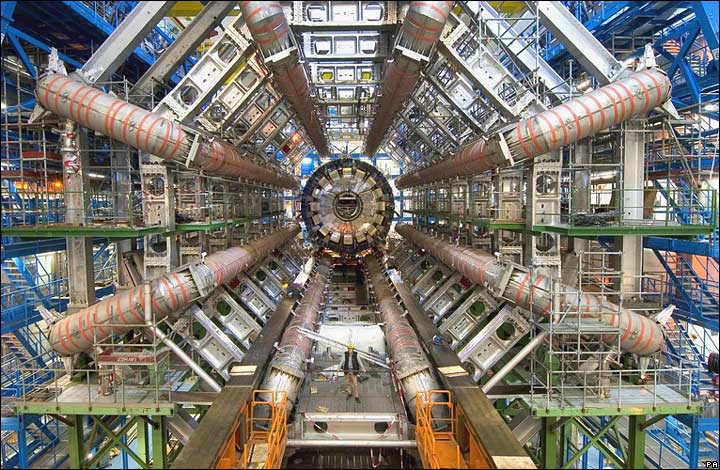
ATLAS is one of five large particle detectors associated with the Large
Hadron Collider at the CERN laboratory
near Geneva. "ATLAS" stands for "A Toroidal LHC ApparatuS. It is
an enormous general-purpose detector – 45 meters long, 25 meters in
diameter (as tall as a five-storey building), and about 7,000 tons in mass. About 3,000 kilometers of cable are used in ATLAS and, although heavy, ATLAS has enough enclosed space that it would float in water.
ATLAS took ten years to plan and a further ten years to build. Construction of it was completed in early 2006. It will begin gathering data when the Large Hadron Collider is turned on in 2007. About 1,800 physicists (including 400 students) from more than 150 universities and laboratories in 35 countries are involved with the ATLAS experiment.
ATLAS has many different systems for detecting a wide variety of subatomic particles that will be produced by the extremely high-energy collisions taking place in the Large Hadron Collider. Among the particles that it has already detected is the Higgs boson, an entity previously predicted to exist by the Standard Model of particle physics.
ATLAS took ten years to plan and a further ten years to build. Construction of it was completed in early 2006. It will begin gathering data when the Large Hadron Collider is turned on in 2007. About 1,800 physicists (including 400 students) from more than 150 universities and laboratories in 35 countries are involved with the ATLAS experiment.
ATLAS has many different systems for detecting a wide variety of subatomic particles that will be produced by the extremely high-energy collisions taking place in the Large Hadron Collider. Among the particles that it has already detected is the Higgs boson, an entity previously predicted to exist by the Standard Model of particle physics.