
Antikythera mechanism
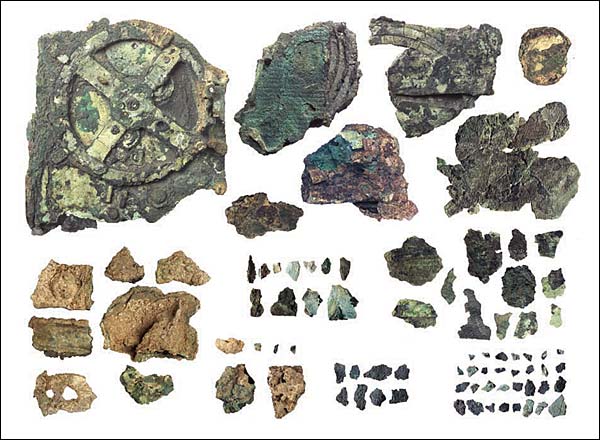
82 fragments of the mechanism have been recovered, containing a total of 30 gears. The largest piece contains 27 of the gears. Credit: Antikythera Mechanism Research Project.

CT scan of a gear fragment. Credit: Antikythera mechanism research project.
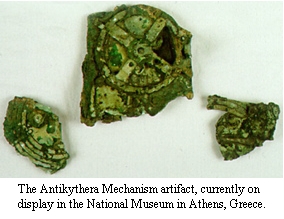
The Antikythera mechanism is an unusual artifact found by sponge divers in 1901 off the coast of the small island of Antikythera near Crete, which appears to have been used for astronomical calculations and predictions. It is the most complicated piece of scientific machinery known from antiquity. The divers had been searching the sunken wreck of a Roman cargo ship and discovered a number of marble and bronze statues before coming across a large piece of corroded bronze. The archaeologist Valerios Stais later noticed that this contained the remains of gear wheel.
The "Antikythera mechanism," it turned out, was made up of a number of gears and wheels. An X-ray analysis of the object showed that the internal gearing was remarkably complex and consisted of a differential gearing system. The device predated by about 1,500 years mechanisms of similar complexity in post-Renaissance Europe. A total of 82 fragments were recovered containing 30 hand-cut bronze gears. The largest fragment has 27 cogs.
Further research (2006)
An Anglo-Greek team published new results on the Antikythera mechanism in 2006. This new work used advanced imaging techniques, such as three-dimensional X-ray microfocus computed tomography, to take detailed pictures of the device and uncover new information. The major structure the researchers describe, like earlier studies, had a single, centrally placed dial on the front plate that showed the Greek zodiac and an Egyptian calendar on concentric scales. On the back, two further dials displayed information about the timing of lunar cycles and eclipse patterns.
The mechanism had some remarkably advanced features to allow for subtle astronomical effects. For example, the Moon sometimes moves slightly faster in the sky than at other times because of its elliptical orbit. To allow for this, the calculator used a pin-and-slot mechanism to connect two gear-wheels that introduced the necessary variations.
New text found on the device, combined with analysis of the dials, hint at the possibility that the Antikythera mechanism could also have displayed planetary motions. Inscriptions mention the word "Venus" and the word "stationary," which suggest that the machine was able to look at retrogressions of planets. As well as calculating the motions of Venus and Mercury, the mechanism might have also been able to display the other planets visible to the naked-eye – Mars, Jupiter, and Saturn – though experts continue to disagree on its exact scope.

