
Bomarc
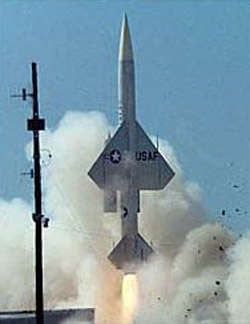
Bomarc was the world's first long-range anti-aircraft missile. Authorized by the US Air Force in 1949, the supersonic Bomarc was developed by Boeing and the University of Michigan Aeronautical Research Center, whose initial letters form its name. Bomarc missiles were housed on a constant combat-ready basis in individual launch shelters in remote areas. The alert signal could fire the missiles around the country in 30 seconds. The Model A (military designation IM-99A) had a range of 200 miles, and the B, which followed, could fly 400 miles (about 650 kilometers) and had a ceiling of over 24,000 m.
The production IM-99A first flew on 24 February 1955. Boeing built 700 Bomarc missiles between 1957 and 1964, as well as 420 launch systems. Bomarc was retired from active service during the early 1970s.
| wingspan | 18 ft 2 in |
| diameter | 35 in |
| length | 45 ft |
| takeoff weight | approx 16,000 lb |
| top speed | More than Mach 2.5 |
| range | More than 400 miles (IM-99B) |
| ceiling | More than 80,000 ft |
| power | 50,000-lb-thrust solid-fuel rocket (takeoff) two 12,000-lb-thrust Marquardt ramjet engines (cruise) |
| Armament | Nuclear warhead |

