
Boomerang Nebula
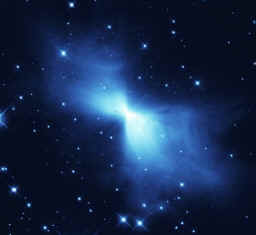
The Boomerang Nebula is a bipolar reflection nebula that lies about 5,000 light-years away in the constellation Centaurus. The symmetric cloud appears to have been created by a high-speed wind of gas and dust blowing from an aging asymptotic giant branch (AGB) star at a speed of 164 kilometers per second. This rapid expansion has cooled carbon monoxide molecules in the nebular gas to a mere 1 K – colder even than the cosmic background radiation – making it the coldest region in the cosmos (outside a lab) ever observed. The ultracool Boomerang shines with light from the central star reflected by dust and is believed to be evolving rapidly, on a timescale of about 1,000 years, to the planetary nebula stage.
| visual magnitude | - |
| angular size | 54" |
| linear size | ~1.3 light-years (0.4 pc) |
| distance | ~5,000 light-years (1,500 pc) |
| position | RA 12h 44m 46.1s, Dec -54° 31' 12" |
| other designations | ESO 172-7 |

