basophil
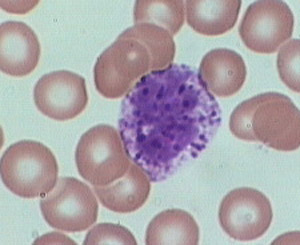
Basophile (stained purple).
Credit: University of Virginia.
A basophil is a granulocyte (a type
of white blood cell) that can secrete a biologically active substance such
as histamine, proteoglycans, or cyclooxigenase
products. Basophils are produced continually by stem
cells in the bone marrow. They are 12–15
microns in diameter. The mature nucleus of a basophile has 2 or 3 lobes.
The function of basophils is not fully understood, but it is known that
they are capable of ingesting foreign particles and produce heparin and histamine (chemicals which induce inflammation),
and are often associated with asthma and allergies. Related cells, known as mast
cells, are often associated with helping provide mediators to initiate
immune responses.