
recognition of biospheres
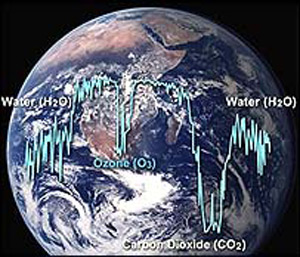
Earth's near-infrared fingerprint.
One of the central challenges in astrobiology is the detection of the signatures of life over interstellar distances. In the case of contemporary terrestrial life, the most distinctive signatures include the high concentration of free oxygen (O2) and ozone (O3) in the atmosphere and the green surface coloration due to chlorophyll, all the result of the activity of plants. Similar features in the spectra of extrasolar planets, when it becomes possible to observe these, will provide strong evidence of Earth-like biospheres.1 Less is known about the principal signatures of the terrestrial biosphere prior to about one billion years ago (see Earth, early history). Further work is needed in this area so that techniques can be developed to search for biospheres akin to that of the primitive Earth. See also Origins Program.
Reference
1. Leger, A., Ollivier, M., Altwegg, K., and Woolf, N. "Is the Presence of H2O and O3 in an Exoplanet a Reliable Signature of a Biological Activity?," Astronomy & Astrophysics, 341, 304 (1998).

