
carbon-nitrogen cycle
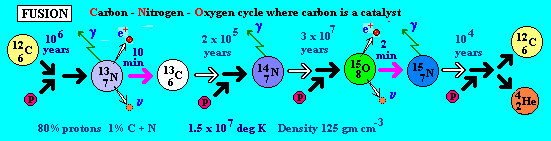
The carbon-nitrogen cycle, also called the carbon-nitrogen-oxygen cycle, is a cycle of six consecutive nuclear reactions resulting in the formation of a helium nucleus from four protons. The carbon nuclei with which the cycle starts are effectively reformed at the end and therefore act as a catalyst. This is believed to be the predominant energy-producing mechanism in stars with a core temperature exceeding about 18 million °C. In lower-mass stars with a lower core temperature, the proton-proton chain predominates.

