4769 Castalia
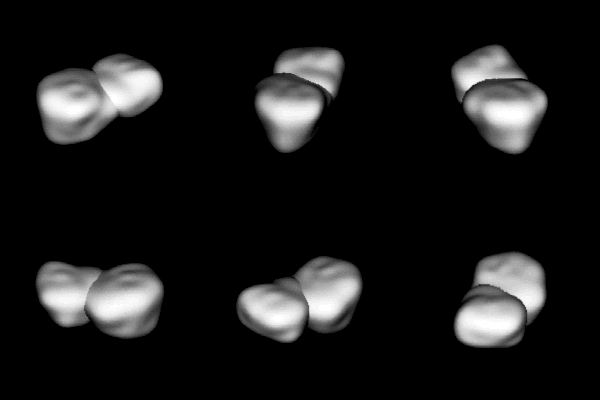
4769 Castalia is an Earth-crossing and potentially hazardous asteroid that is a member of the Apollo group, discovered by Eleanor Helin (Caltech) and colleagues. Castalia became the first asteroid for which astronomers were able to generate an image. In August 1989, when it passed 5.6 million kilometers from Earth (11 times the distance of the Moon), Steven Ostro and his group, at the Jet Propulsion Laboratory, bounced radar beams off Castalia using the Arecibo radio telescope. The three-dimensional model built from the resulting data was of a double-lobed object – a peanut shape – nearly 1.8 kilometers across at its longest. This suggests that Castalia consists of two 800-meter pieces resting together: the first known contact-binary object in the solar system. Radar echoes from other near-Earth asteroids have since shown that this configuration is quite common.
| diameter | 1.8 × 0.8 km |
| density | 2.1 g/cm3 |
| spectral class | S |
| rotational period | 4 hours |
| semimajor axis | 1.063 AU |
| eccentricity | 0.4831 |
| inclination | 8.89° |
| period | 1.10 years |