
calcite
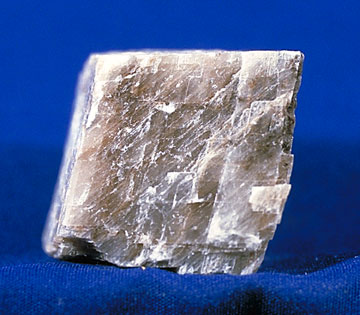
Calcite. Credit: Mineral Information Institute.
Calcite is a crystalline form of calcium carbonate (CaCO3). Calcite is one of the most common and widespread minerals. It crystallizes in the hexagonal system, the main crystal forms being the nail-head, dog-tooth, and prismatic. It also occurs as fine to coarse granular aggregates, encrustations, and stalactitic growths. The crystals cleave perfectly into rhombohedra. Calcite is usually colorless or glassy white, but may have gray, yellow, blue, red, pink, brown, or black tints. It has a hardness of 3 on the Mho scale and a specific gravity of 2.72.
Calcite has the property of double refraction, which is apparent in the transparent variety of calcite known as Iceland spar. Stalactites are pendent forms consisting of concentric layers of calcite deposited by the evaporation of water containingt calcium carbonate dripping from the roofs of limestone caves. Stalagmites are complimentary columns rising from the floor of caves where drops of water falling from stalactites have landed (see stalactites and stalagmites). Calcareous tufa consists of a more or less cellular deposit of calcium carbonate deposited from water containing calcium carbonate in solution.
Calcite is an important rock-forming mineral and a major constituent of limestone, marble, chalk, and carbonatites. It is used in the manufacture of lime, cement, and fertilizers.

