
color index
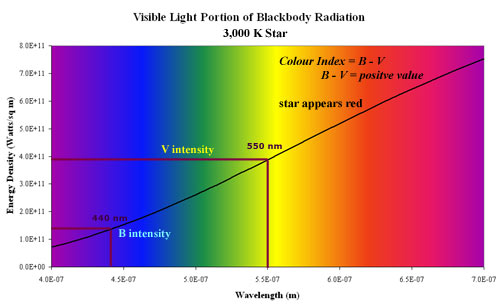
Figure 1. Measurement of color index for a cool star. The calibration of the color index scale means that a star of spectral class A0 and luminosity class V (i.e. a main sequence star) has a color index of 0.0. Vega, (Alpha Lyrae) is such a star. Stars hotter than Vega will have a negative color index and appear more bluish. Stars with a positive color index are cooler than Vega and will appear more yellow, orange, or red. Credit: CSIRO.
Color index is the difference between the apparent magnitude of a star at two different wavelengths (always the shorter-wavelength magnitude minus the longer-wavelength magnitude) to give a quantification of the star's color.
In the widely used Johnson system, a star's brightness is measured through a U filter, which transmits ultraviolet and violet light, a B filter, which lets through blue light, and a V ("visual") filter, which lets through green-yellow light (to which the human eye is most sensitive). If a star's observed magnitudes, corrected for absorption in Earth's atmosphere, are U, B, and V, then the color indices are the differences U – B and B – V. The system is defined so that for a star of spectral type A0 (equivalent to a surface temperature of 9,200 K), B – V = U – B = 0. Hotter (bluer) stars have slightly negative color indices, while cooler (yellow, orange, and red) stars have increasingly positive color indices (Fig 1). The full range runs from about -0.4 (blue) to +2.0 (red carbon stars).
Color indices can also be defined that are sensitive to spectral lines or bands. By comparing several different color indices it is possible to deduce such important quantities as a star's temperature and intrinsic luminosity, and the extent to which its light has been absorbed by interstellar dust (see intrinsic color index).
Color index is often referred to simply as color. However, note that the "shade" of color is an indistinct term whereas the color index is a directly measurable value.

