
Dobzhansky, Theodosius (1900–1975)
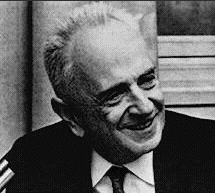
Theodosius Dobzhansky was a Russian-born American geneticist and zoologist, famed for his study of the fruit fly, Drosophila, which demonstrated that a wide genetic range could exist in even a comparatively well-defined species.
Dobzhansky emigrated to the United States in 1927 and joined Thomas Hunt Morgan's group at Columbia University. The following year he moved with Morgan to the California Institute of Technology and became a professor there in 1936. Dobzhansky's studies in population genetics served as a basis for his explanation of how the evolution of races and species could have come about through adaptation. His key discovery was that successful species tend to harbor a large pool of genes which allows them to survive and adapt effectively in the event of environmental change.
He concurred with George Gaylord Simpson that a rerun of history would not recreate human beings and that while natural selection might lead to many other forms of life and intelligence elsewhere it space, it would be unlikely to fashion a duplicate of humanity (see anthropomorphism). He wrote:1
Natural scientists have been loath, for at least a century, to assume that there is anything radically unique or special about the planet Earth or about the human species. This is an understandable reaction against the traditional view that Earth, and indeed the whole universe, was created specifically for man. The reaction may have gone too far. It is possible that there is, after all, something unique about man and the planet he inhabits.
His writings include Genetics and the Origin of Species (1937), Mankind Evolving (1962), and Genetics of the Evolutionary Process (1970).
Reference
1. Dobzhansky, T. "Darwinian Evolution and the Problem of Extraterrestrial Life," Perspectives in Biology and Medicine, 15, 157 (1972).

