
intelligent dinosaurs
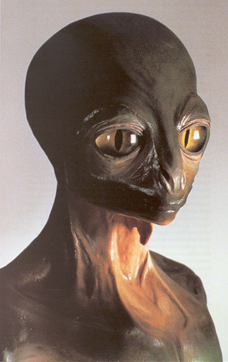
"Dinosauroid." Sculpture by Dale Russell and Ron Seguin, 1982, Canadian Museum of Nature, Ottawa, Canada.
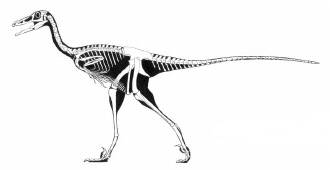
Troodon (Stenonychosaurus unequalis).
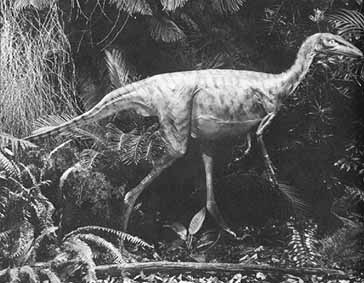
Reconstruction of Stenonychosaurus.
The Voths.
What would have happened if the asteroid that supposedly hit the Earth at the end of the Cretaceous period (see Cretaceous-Tertiary Boundary), 65 million years ago, had missed? One possibility is that the dinosaurs would not have become extinct, advanced mammals would subsequently not have appeared, and some of the descendants of dinosaurs might have evolved to become intelligent in our place.
It's clear that some dinosaurs were getting smarter at the time the asteroid
that hit the Yucatan, and created the Chixulub
Crater, handed the gauntlet to the mammals (fortunately for us). One
of the brainiest dinosaurs we know about at the end of the Cretaceous was Troodon (aka Stenonychosaurus inequalis) a 1.2-meter-tall,
70-kilog ramcarnivorous dinosaur with perhaps the intelligence of an opossum.
What if Troodon had survived and continued to evolve and get brainier? In
the early 1980s, paleontologist Dale Russell, curator of vertebrate fossils
at the National Museums of Canada, in Ottowa, explored this possibility.1 Had the dinosaurs survived, argued Russell, and a species like Troodon grown
smarter, it would eventually have needed to stand upright to balance its
heavy head. A shoulder structure would have evolved to allow the "dinosauroid"
to throw objects. Projecting how other characteristics of this species might
have developed he came up with a model of a large-brained, reptilian biped
with enormous eyes, three-fingered hands, an absence of external genitalia
(typical of reptiles), and a navel (since a placenta is found in some modern
reptiles and may have been needed to enable the birth of young with big
brain cases).
Was Troodon the last word on dinosaur intelligence or are there fossils of even smarter species waiting to be found? It has been argued that some
dinosaurs may have got to be really brainy – to the point of hominid
intelligence. We've no evidence for this, of course, but it isn't such an
outrageous hypothesis. At least, it's an interesting point when thinking
about alternative evolutionary scenarios. The dinosaurs were around for
a very long time – from about 225 to 65 million years ago. Consider
how far mammals have progressed since the end of the Cretaceous (a period
less than half as long): from creeping around in trees to launching Jupiter
probes! Consider how rapidly humanoid intelligence has advanced in the past
3 million years. Dinosaurs certainly had time to grow big brains and even
develop a culture and civilization. Did they? Probably not, but it isn't
out of the question. After all, what clues will be left to our own civilization
and technology after 65 million years of erosion and earth movements?
Intelligent dinosaurs in science fiction
In the Star Trek Voyager episode "Distant Origin", a sentient race of space-faring dinosaurs (the Voths, see illustration) on the far side of the Galaxy discover they may have originated on Earth.
Also in science fiction, Harry Harrison explored the consequences of saurian intelligence in his West of Eden series.
Reference
1. Russell, D. A. and Sequin, R. "Reconstruction of the small Cretaceous theropod Stenonychosaurus inequalis and a hypothetical dinosauroid," Syllogeous, 37, 1 (1982).

