
Edison effect
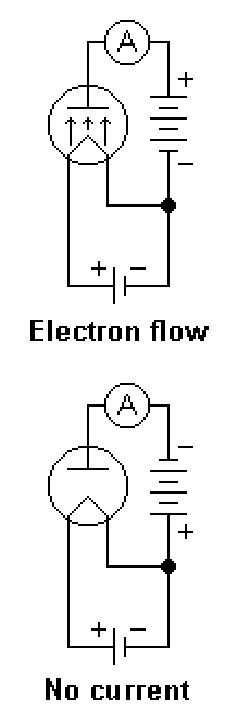
The Edison effect in a diode tube. A diode tube is connected in two configurations, one has a flow of electrons and the other does not. Note that the arrows represent electron current, not conventional current.
The Edison effect is the flow of an current through a laboratory vacuum, between two metal wires, one of which is heated. The current flows only when the heated wire is more negative, because it is carried by free electrons released from the wire by its heat. The Edison effect, named after its discoverer, Thomas Edison, was the principle behind "vacuum tubes" used in radio and television receivers and transmitters before the invention of the transistor.

