
Enceladus

Giant plumes of ice are seen erupting in this mosaic of images captured by Cassini during a flyby of Enceladus in November 2009.
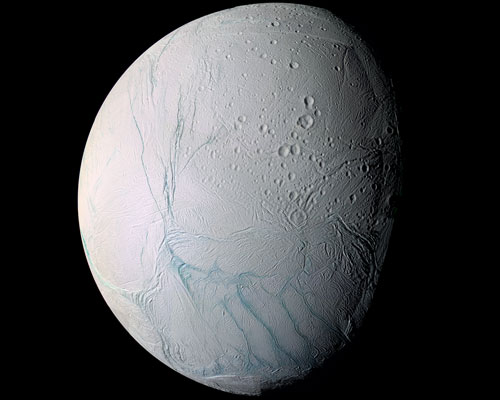
Enceladus as seen by the Cassini spacecraft on 14 July 2005. This false-color, mosaic view of the hemisphere facing away from Saturn was made from 21 narrow-angle camera images taken at ultraviolet to infrared wavelengths. In false-color, many long fractures on Enceladus show a marked difference in color (represented here in blue) from the surrounding terrain. The original images range in resolution from 350 to 67 meters (1,148 to 220 feet) per pixel and were taken at distances ranging from 61,300 to 11,100 kilometers (38,090 to 6,897 miles). (NASA/JPL.)
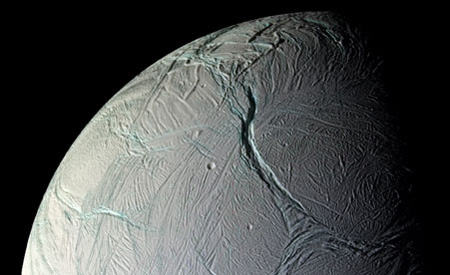
The mosaic of fractures, folds and ridges in the surface of Enceladus, captured by Cassini. (NASA/JPL/Space Science Institute.)
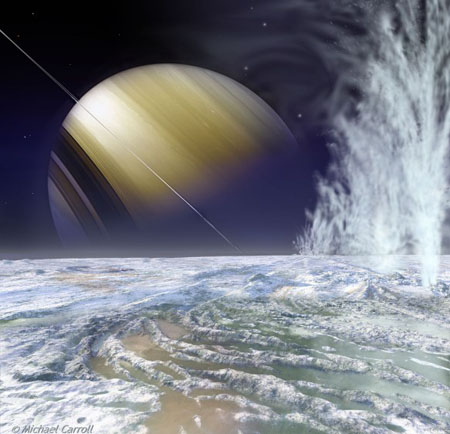
Artist impression of ice volcanoes on Enceladus. (Michael Carroll.)
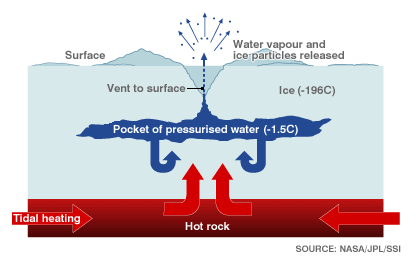
How a cold geyser on Enceladus might work.
Enceladus is the sixth largest moon of Saturn, discovered by William Herschel on 28 August 1789. It is also known as Saturn II. Enceladus has attracted much interest recently because of the icy plumes that have been seen erupting from cracks near the moon's south pole. These emanations hint at the existence of a body of water just below the surface, which in turn encourages speculation about the possibility of life. Enceladus is one of only three worlds in the Solar System in which active eruptions have been observed (the others being Io and Triton).
| discovery | 1789, by William Herschel |
| semimajor axis | 237,948 km (147,978 mi) |
| diameter | 513 × 503 × 497 km (319 × 313 × 309 miles) |
| mean density | 1.61 g/cm3 |
| escape velocity | 0.241 km/s (868 km/h, 539 mph) |
| orbital period | 1.370 days (1 d 8 h 52 min) |
| orbital eccentricity | 0.0047 |
| orbital inclination | 0.02° |
| axial period | synchronous |
| visual albedo | 0.99 |
Enceladus orbits within Saturn's tenuous, outermost ring, the E-ring. The surface coating of pristine ice makes it the most reflective object known in the solar system. It is also the most geologically evolved member of Saturn's satellites, displaying a young surface with at least five distinct types of terrain. Even the most heavily cratered areas of Enceladus are much more lightly pock-marked than the other icy satellites, while some regions are crater-free down to a resolution of 2 kilometers (1.2 miles), indicating that the surface has undergone major change within the last 1 billion years, and has been geologically active within the last 100 million years. On either edge of the ridged plains, a series of truncated craters indicate that melting of the surface occurred after the end of the intense bombardment phase. Linear markings in the southern hemisphere are rectilinear fault lines associated with movement of the crust. Other, curved lines appear to be a complex system of ridges, similar to the grooved terrain on Ganymede.
All of this suggests that Enceladus must have an interior that is kept in a liquid state. But how? One possibility is tidal heating due to the gravitational effects of Saturn and the large, neighboring moons Dione (with which Enceladus is locked in a 1:2 resonance) and Tethys. Many researchers, however, fail to see how tidal heating could be a major factor because the orbit of Enceladus is not sufficiently elongated (eccentric). A question mark hangs over other possible heating mechanisms, too. Enceladus doesn't have enough interior rocks for radioactive heating, nor does it have enough ammonia to lower its melting temperature.
Whatever is heating Enceladus may also drive cryovolcanism (ice volcanism), which has been proposed as the source of material in the E-ring and also of the moon's thin atmosphere. The latter was detected by the Cassini spacecraft in 2005. It consists primarily of water vapor with much lower amounts of nitrogen, carbon dioxide and other simple carbon-based molecules (organics). These gases are concentrated at the south pole of the moon, which is also a "hotspot", hovering at a relatively balmy minus –183 °C compared to a temperature for the rest of the moon of about –201°C (–330 °F).
South pole, ice plumes, and astrobiology
The south pole of Enceladus is evidently the scene of significant, ongoing geological and possibly hydrological action. The south polar region is cut by parallel cracks roughly 130 kilometers (81 miles) long and 40 km (25 miles) apart. These cracks, dubbed "tiger stripes," vent vapor and fine ice water particles that have crystallized on Enceladus' surface as recently as 1,000 years to 10 years ago. The fine ice material is probably the major source of particles that replenish Saturn's E ring.
Various ideas have been put forward to explain the activity taking place at the south pole. One suggestion is that it's being driven by liquid water perhaps as little as 10 meters below the surface. (This contrasts with the several kilometers depth suspected for liquid water oceans on Europa and several other larger moons in the solar system.) Although Cassini hasn't seen ice geysers or ice volcanoes, the lack of ammonia and the sheer volume of water vapor escaping suggests that pure-water volcanism exists on Enceladus.
Jeffrey Kargel, from the US Geological Survey in Flagstaff, Arizona, believes that shifting, glacier-like tectonic plates and tidal forces could generate and trap heat to produce the activity seen on Enceladus. His modeling also allows for a deep liquid water ocean saturated with gases such as carbon dioxide. This CO2 may either be locked up in the icy crust or may exist as an icy clathrate seafloor below the hypothesized ocean. Other researchers on the Cassini mission say the plume at the south pole may be erupting from near-surface pockets of liquid water, like cold versions of the Old Faithful geyser in Yellowstone Park. Simple organics, including methane, ethane, and ethylene, have been detected in the "tiger stripes" at the south pole. Methane has probably been locked up inside Enceladus since the solar system formed and is now bubbling up through the vents. All this makes Enceladus of great interest to the astrobiologist. Most likely, there is subsurface liquid water, simple organics, and water vapor welling up from below. Over billions of years, heating of this cocktail of simple organics, water, and nitrogen could have led to some of the most basic building blocks of life.
Possibility of life on Enceladus
Could microbial life exist inside Enceladus, where no sunlight reaches, photosynthesis is impossible, and no oxygen is available? To answer that question, we need look no farther than our own planet to find examples of the types of exotic ecosystems that could make life possible on Saturn's 310-mile-wide geyser moon. The answer appears to be, yes, it could be possible. It is this tantalizing potential that brings us back to Enceladus for further study.
In recent years, life forms have been found on Earth that thrive in places where the sun doesn't shine and oxygen is not present because no photosynthesis takes place. Microbes have been discovered that survive on the energy from the chemical interaction between different kinds of minerals, and others that live off the energy from the radioactive decay in rocks. The ecosystems are completely independent of oxygen or organic material produced by photosynthesis at Earth's surface. These extraordinary microbial ecosystems are models for life that might be present inside Enceladus today.
There are three such ecosystems found on Earth that would conceivably be a basis for life on Enceladus. Two are based on methanogens, which belong to an ancient group related to bacteria, called the archaea – the rugged survivalists of bacteria that thrive in harsh environments without oxygen. Deep volcanic rocks along the Columbia River and in Idaho Falls host two of these ecosystems, which pull their energy from the chemical interaction of different rocks. The third ecosystem is powered by the energy produced in the radioactive decay in rocks, and was found deep below the surface in a mine in South Africa.
So the evidence points to the feasibility of life in Enceladus. But how would it get its start? A major problem in answering that question is that we don't know how life originated on Earth, nor have we been able to reproduce Earth's first spark of life in the laboratory. But here's the good news: there are a lot of theories for how life originated on Earth. Now the question is – do they apply to Enceladus?
Two of the theories for the origin of life on Earth do seem to apply to Enceladus –the "primordial soup" theory and the deep sea vent theory.
Primordial soup theory
The theory that the origin of life occurred in a soup of organic material that came together from non-biological sources traces back to Charles Darwin, and was demonstrated in a famous experiment in 1953 when the chemists Stanley L. Miller and Harold C. Urey cooked up a primordial soup of chemicals thought to have been present on early Earth before life began (see Miller-Urey experiment). A spark, simulating lightning, was passed through this highly reduced mixture of methane, ammonia, water vapor and hydrogen. Within two weeks, a few amino acids, some of the building blocks of life, had formed in the soup. While Miller and Urey did not actually create life, they demonstrated that very complex molecules – amino-acids – could emerge spontaneously from simpler chemicals.
On Earth, it's possible that the organic ingredients of the soup were produced from existing materials on the early Earth. Another theory is that the right soup mix ingredients arrived as incoming comet material and interplanetary dust (see origin of life).
Organic chemicals were part of the raw material from which Enceladus and Saturn's other moons formed. The origin of Enceladus' heat is less clear, but there are several possibilities that could have given Enceladus a layer of liquid water that persists today. Early on, it could have been heated by decay of short-lived radioactivity in rocks, with the heating prolonged by tidal influences. Or perhaps an earlier oblong orbit could have brought more tidal heating than exists there today. A past tidal relationship with another moon could have caused the heat. Another theory says the heat could have been produced from a process called serpentization, where chemical binding of water and silicate rock could occur at the upper layer of the moon's core. This increases the volume of the rock and creates energy in the form of heat.
Any of these heating mechanisms might have created a liquid subsurface aquifer solution rich in organics, allowing Enceladus to serve up a suitable prebiotic soup.
Deep sea vent theory
The deep sea vent theory for the origin of life on Earth might apply to Enceladus as well. In this scenario, life on Earth began at the interface where chemically rich fluids, heated by tidal or other mechanisms, emerge from below the sea floor. Chemical energy is derived from the reduced gases, such as hydrogen-sulfide and hydrogen coming out from the vent in contact with a suitable oxidant, such as carbon dioxide. Hot spots on an Enceladus sea floor could be locales for this type of process.
We don't know how long it takes for life to start when the ingredients are there and the environment is suitable, but it appears to have happened quickly on Earth. So maybe it was possible that on Enceladus, life started in a "warm little pond" below the icy surface occurring over the last few tens of millions of years.
For life to persist once it has been established requires an environment of liquid water, the essential elements and nutrients, and an energy source. At Enceladus, we have evidence for liquid water, but we don't know its origin. We have observed simple organic chemicals there, and the March 12 close flyby indicates there are some complex organic chemicals, as well. An energy source of some sort is producing geysers. As Cassini's exploration continues, we're seeking to bring together more pieces of this intriguing puzzle.
The first step toward answering the question of whether life exists inside the subsurface aquifer of Enceladus is to analyze the organic compounds in the plume. Cassini's March 12 passage through the plume provided some measurements that help us move toward an answer, and preliminary plans call for Cassini to fly through the plume again for more measurements in the future. Ultimately, another mission in the future could conceivably land near the plume or even return plume material to Earth for laboratory analysis.
[This section on the possibility of life on Enceladus was written by Chris McKay / Dennis Matson.]
