
endoliths
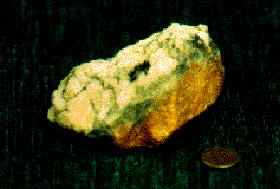
Endolithic cyanobacteria.
Endoliths are organisms that live inside rock, or the tiny pores between interlocking mineral grains. Thousands of different species are known, including representatives of bacteria, archaea, and fungi. Endoliths have been found inhabiting Earth's crust at depths up to nearly 3 kilometers (2 miles).1 Many are autotrophs which manufacture their own organic compounds from inorganic chemicals in the rock. Other varieties of endolith feed on the organics produced by the autotrophs, giving rise to microscopic underground communities known as SLiMEs (Subsurface Lithotrophic Microscopic Environments). The extreme depth at which endoliths can exist has yet to be established. The main problem that organisms face at increasing depth is not so much the very high pressure but the rising temperature. Hyperthermophiles are known which thrive in the vicinity of black smokers at a temperature of over 110°C. For oceanic crust, where the temperature rises about 15°C per kilometer of depth, a tolerance of 110°C would allow microbial life to extend down to about 7 kilometers below the seafloor. For continental crust, where the temperature rise is faster, a 110°C threshold would allow life to continue at depths of up to 4 kilometers.
In 1998, evidence was also found of "rock-eating" microbes at depths of about 1.5 kilometers (~1 mile) beneath the ocean floor. A team from Oregon State University found minute tracks in core samples of basalt obtained from under the Pacific, Atlantic, and Indian oceans by the Ocean Drilling Program. In every case where a track was examined closely it was found to contain DNA. One theory is that the organisms which create such trails are seeking micronutrients from the rock in the form of iron, potassium, or sulfur. They appear either to consume the rock or excrete some kind of acid that dissolves it.
The discovery of endoliths, and the varied and innovative means by which they acquire nutrients and energy, brings closer the prospect that life arises frequently in the universe. Wherever there is internal heat, the presence of some underground water, and a supply of inorganic chemical nutrients, as, for example, there may be on Mars, the large moons of the gas giants, and even comets, then subsurface life may exist.
Reference
1. Kerr, R. A. "Life Goes to Extremes in the Deep Earth - and Elsewhere?," Science, 276, 703 (1997).

